
Author: headless_sync

  • Myers Capital Hawaii Opens New Virginia Branch

    Myers Capital Hawaii Opens New Virginia Branch

    March 1, 2022

    Myers Capital Hawaii Opens New Virginia Branch Providing Residential and Commercial Mortgages

    HONOLULU – Myers Capital Hawaii, a locally-owned 24-year-old company offering residential and commercial mortgages, recently announced the opening of a new branch office in Virginia. Named Myers Capital Virginia, the branch is headed by manager Tara Weston, a Senior Mortgage Advisor with more than 8 years of residential and commercial lending experience.

    Myers Capital Virginia offers a wide range of mortgage programs for residential and commercial real estate, including traditional home purchases, fix and flip bridge loans, and home equity loans.

    “We have been looking to expand our mortgage services from Hawaii to the U.S. Mainland and Virginia was a top choice for us due to its robust housing and jobs market,” says Reed Myers, Principal of Myers Capital Hawaii and Myers Capital Virginia. “We are focused on helping borrowers with their real estate financing needs with a wide range of products at highly competitive rates backed by our excellent service standards.”

    Myers Capital Virginia serves Northern Virginia, Richmond, Roanoke, and Virginia Beach areas. Their products can be used to finance the purchase of residential homes, investment properties, and other income-producing real estate including apartment complexes.

    Myers Capital Virginia provides financing for commercial properties including office buildings, retail spaces and warehouses. These loans are designed to help business owners and investors purchase commercial property, renovate or creatively restructure their debt.

    The Virginia branch is managed by Tara Weston, who began her mortgage career with Myers Capital Hawaii. She started as a loan processor, moving up to mortgage advisor, and now branch manager. A graduate of Virginia Tech, Tara specializes in residential and commercial mortgage lending.

    “Myers Capital Virginia is a relationship-based mortgage company offering more than just financing for clients to buy homes or investors looking to build a real estate portfolio,” says Reed. “A key benefit that we provide to all clients is expert mortgage planning, which is designed to help borrowers meet both their real estate financing needs and overall financial goals. We provide guidance to help clients properly structure their real estate financing with their life goals.”

    To learn more about the Virginia branch, visit www.myerscapitalvirginia.com or call 804-404-2202.

    ABOUT MYERS CAPITAL HAWAII
    Since 1998, Myers Capital Hawaii is a leading locally-owned mortgage and financial services company offering residential and commercial mortgages with real estate advisory services. The company helps a wide range of borrowers from first-time homebuyers to existing homeowners looking to refinance and real estate investors to business owners who need capital. As a family-owned, relationship-driven company, Myers Capital Hawaii takes an all-encompassing approach in providing mortgage solutions and expert guidance to find the right loan program to help clients achieve their short- and long-term real estate and financial goals. Find out more at myerscapitalhawaii.com or visit @myerscapitalhawaii on Facebook and Instagram.

    ABOUT MYERS CAPITAL VIRGINIA
    Myers Capital Virginia, a subsidiary and branch of Myers Capital Hawaii, offers residential and commercial mortgages to Northern Virginia, Richmond, Roanoke, and Virginia Beach areas. Find out more at myerscapitalvirginia.com or visit @myerscapitalvirginia on Facebook and Instagram.

    MEDIA CONTACT:
    Reed Myers, Principal
    Myers Capital Hawaii
    Phone: 808-566-6611
    Email: reed@myerscapital.com

    A PDF of this press release can be downloaded here.
     

  • How Inflation and Rising Rates Affect Buying Power

    How Inflation and Rising Rates Affect Buying Power

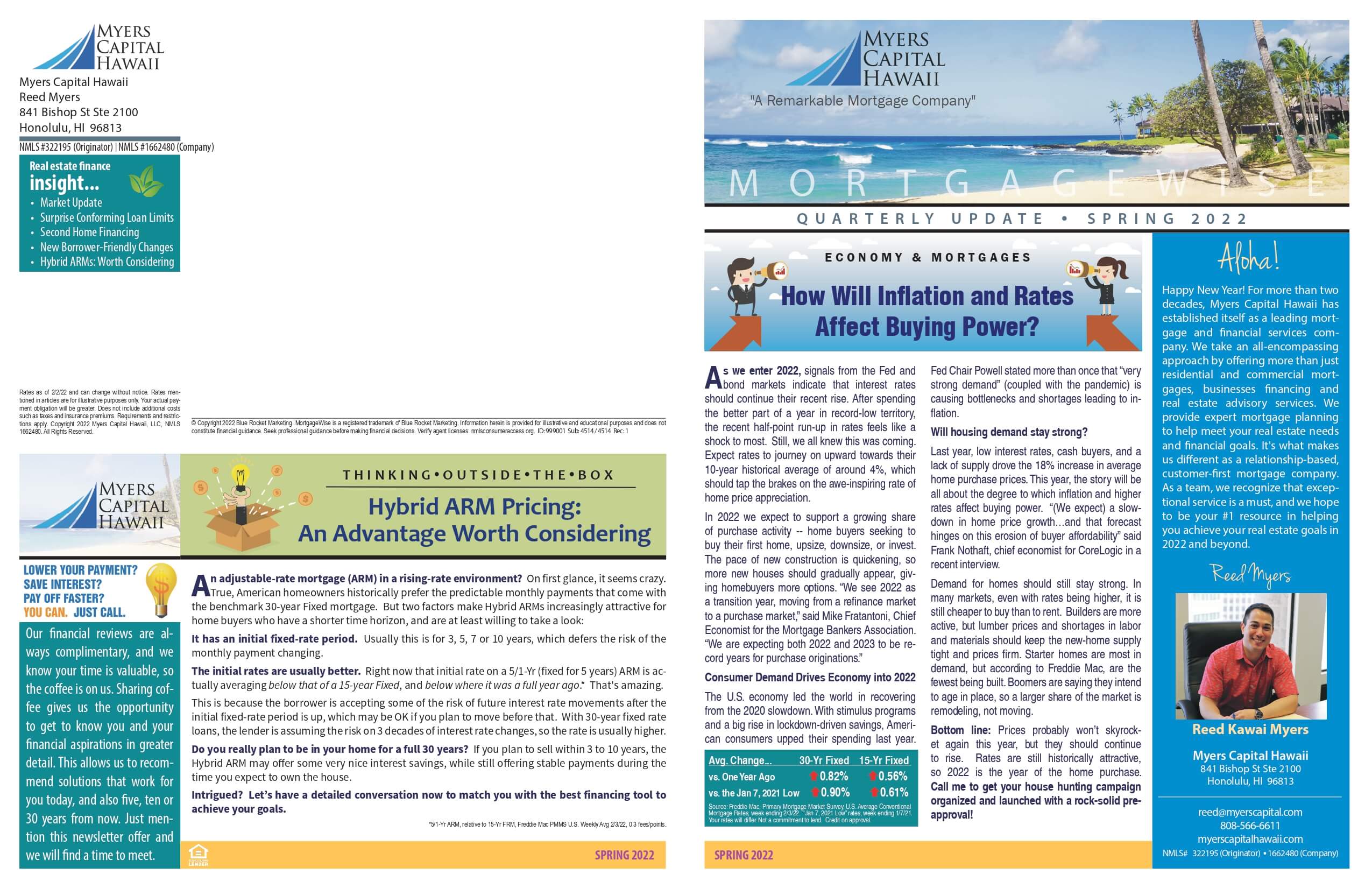
    As we enter 2022, signals from the Fed and bond markets indicate that interest rates should continue their recent rise. After spending the better part of a year in record-low territory, the recent half-point run-up in rates feels like a shock to most. Still, we all knew this was coming. Expect rates to journey on upward towards their 10-year historical average of around 4%, which should tap the brakes on the awe-inspiring rate of home price appreciation.

    In 2022 we expect to support a growing share of purchase activity — home buyers seeking to buy their first home, upsize, downsize, or invest. The pace of new construction is quickening, so more new houses should gradually appear, giving homebuyers more options. “We see 2022 as a transition year, moving from a refinance market to a purchase market,” said Mike Fratantoni, Chief Economist for the Mortgage Bankers Association. “We are expecting both 2022 and 2023 to be record years for purchase originations.”

    Consumer Demand Drives Economy into 2022
    The U.S. economy led the world in recovering from the 2020 slowdown. With stimulus programs and a big rise in lockdown-driven savings, American consumers upped their spending last year. Fed Chair Powell stated more than once that “very strong demand” (coupled with the pandemic) is causing bottlenecks and shortages leading to inflation.

    Will housing demand stay strong?
    Last year, low interest rates, cash buyers, and a lack of supply drove the 18% increase in average home purchase prices. This year, the story will be all about the degree to which inflation and higher rates affect buying power. “(We expect) a slowdown in home price growth…and that forecast hinges on this erosion of buyer affordability” said Frank Nothaft, chief economist for CoreLogic in a recent interview.

    Demand for homes should still stay strong. In many markets, even with rates being higher, it is still cheaper to buy than to rent. Builders are more active, but lumber prices and shortages in labor and materials should keep the new-home supply tight and prices firm. Starter homes are most in demand, but according to Freddie Mac, are the fewest being built. Boomers are saying they intend to age in place, so a larger share of the market is remodeling, not moving.

    Bottom line: Prices probably won’t skyrocket again this year, but they should continue to rise. Rates are still historically attractive, so 2022 is the year of the home purchase. Contact us to get your house hunting campaign organized and launched with a rock-solid preapproval!

    Quarterly Newsletter – Spring 2022
    Enjoyed this article? Get the latest mortgage industry news. Click here

    Copyright © 2022 Myers Capital Hawaii

  • Mortgage Newsletter Spring 2022

    Mortgage Newsletter Spring 2022

    Get the latest mortgage industry news. Click here.

    – Economy & Mortgages: How Will Inflation and Rates Affect Buying Power?

    – Official 2022 Conforming Loan Limit Increase Exceeds Expectations

    – Work From Anywhere? Second Homes Still a Hot Commodity

    – Borrower-Friendly Changes Could Help Homebuyers: Desktop Appraisals and Rent History Considered

    – Hybrid ARM Pricing: An Advantage Worth Considering

    Copyright © 2022 Myers Capital Hawaii

  • 4 Things to Consider Before Financing a Home Together Before Marriage

    4 Things to Consider Before Financing a Home Together Before Marriage

    The National Association of Realtors reported recently that close to 10% of homebuyers in 2020 were unmarried couples. This may be because rising rents and low interest rates make homeownership financially more attractive than living together in a rented home or apartment.
    Buying property together prior to marriage, however, has challenges that smart couples tackle up front, even though it takes some of the romance out of making such a big commitment — especially the part where you talk about what happens if you break up or someone dies.

    Like any partnership, it’s critical to have a written agreement that spells out who is responsible for what today, and in the future. Having those tough conversations before buying the property will avoid a major headache should the relationship change.

    We recommend working with a real estate attorney (who we can recommend) to create a property agreement that anticipates the many possible eventualities.

    Some questions to think about:
    What is the ownership share for each partner? Is it 50/50 or unequal?

    Who is applying for the mortgage? If one partner has poor credit, this could be an approach to take, but it puts all the obligation for paying back the loan on the other partner regardless of ownership percentage.

    What is each partner’s expected contribution toward regular and unexpected expenses? (think: new roof, broken window, regular maintenance, etc.)

    How will you hold title on the property? The options are sole ownership (often riskier), joint tenancy (equal shares with right of survivorship), and tenants in common (probably the most common for unmarried couples, unequal shares OK). This decision is critical to think through carefully, and the outcomes are different if one partner wants to sell or passes away. And, the agreement should spell out what happens when you get married!

    This gives you a taste for the detailed conversations the couple needs to have before making the commitment to buy a home together. Please contact us to talk about all the issues in more detail if you or any family members plan to take this step!

    Copyright © 2022 Myers Capital Hawaii

  • 2022 Conforming Loan Limits

    2022 Conforming Loan Limits

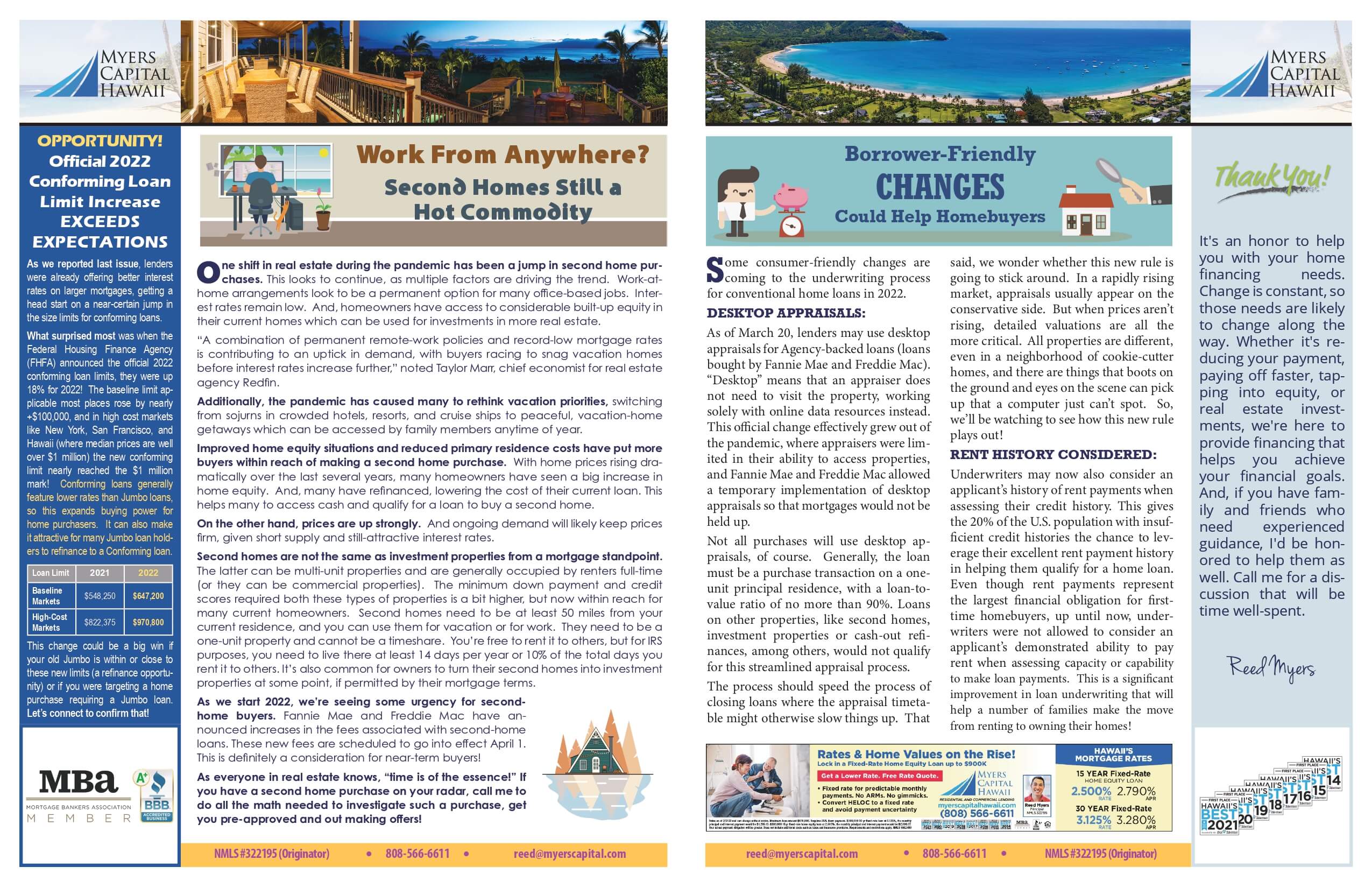
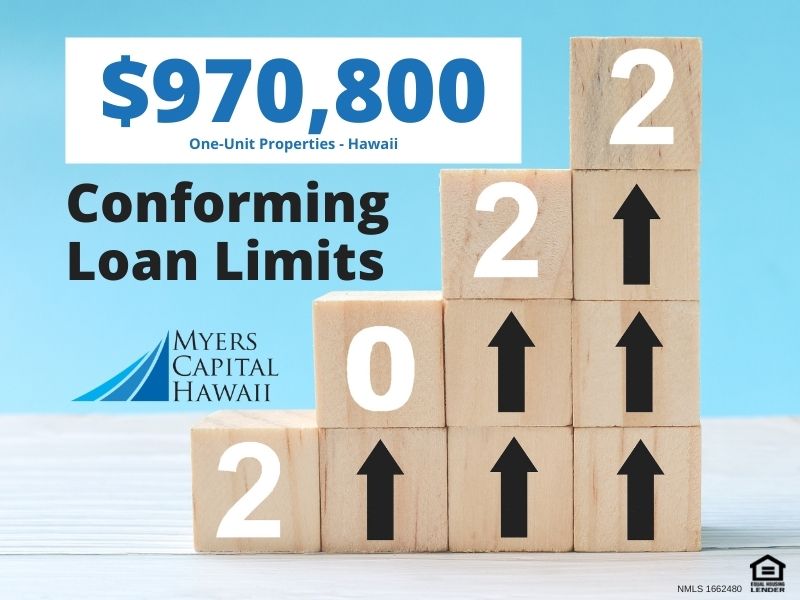
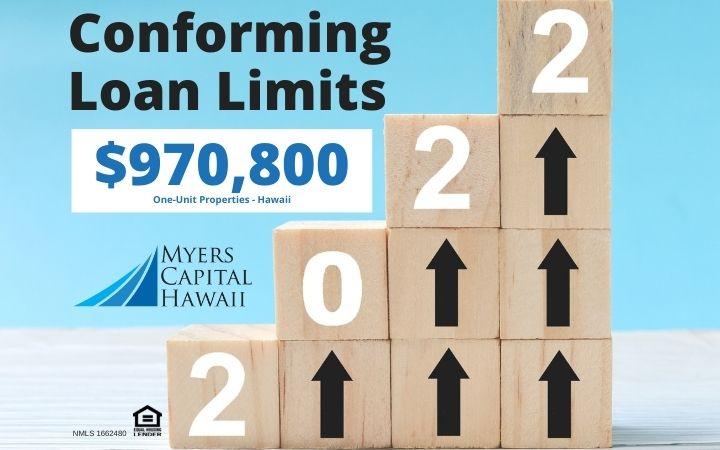
    The 2022 conforming limits for conventional mortgages were announced today by the Federal Housing Finance Agency (FHFA). Hawaii falls in a high-cost area and has a base loan limit that rose to nearly $1 million from the current $822,375.

    2022 High-Cost Area Loan Limits – Hawaii Properties:  
    – One-unit property: $970,800
    – Two-unit property: $1,243,050
    – Three-unit property: $1,502,475
    – Four-unit property: $1,867,275

    These 2022 higher loan limits for Hawaii and other high-cost areas are set at 150% of the national conforming loan limit, which starts at $647,200. Loan limits are tied to median home prices and 2021 featured strong sales and rising prices. In fact, the average sales price topped $1 million for the first time in Hawaii history. It occurred in the month of August 2021, when the median price of a single-family home on Oahu reached $1,050,000.

    Higher loan limits allow borrowers to use conventional loans to make a purchase or refinance an existing loan without the need for a jumbo loan. Jumbo loans (non-conforming loans) have higher interest rates, increased costs, a larger down payment, and have more stringent credit and overall qualification requirements.

    2022 conforming loan limits are available by clicking here.

    Find out whether you qualify for these higher conforming loan amounts. Apply now or contact us for a no-cost consultation. 

  • Rates Poised to Rise

    Rates Poised to Rise


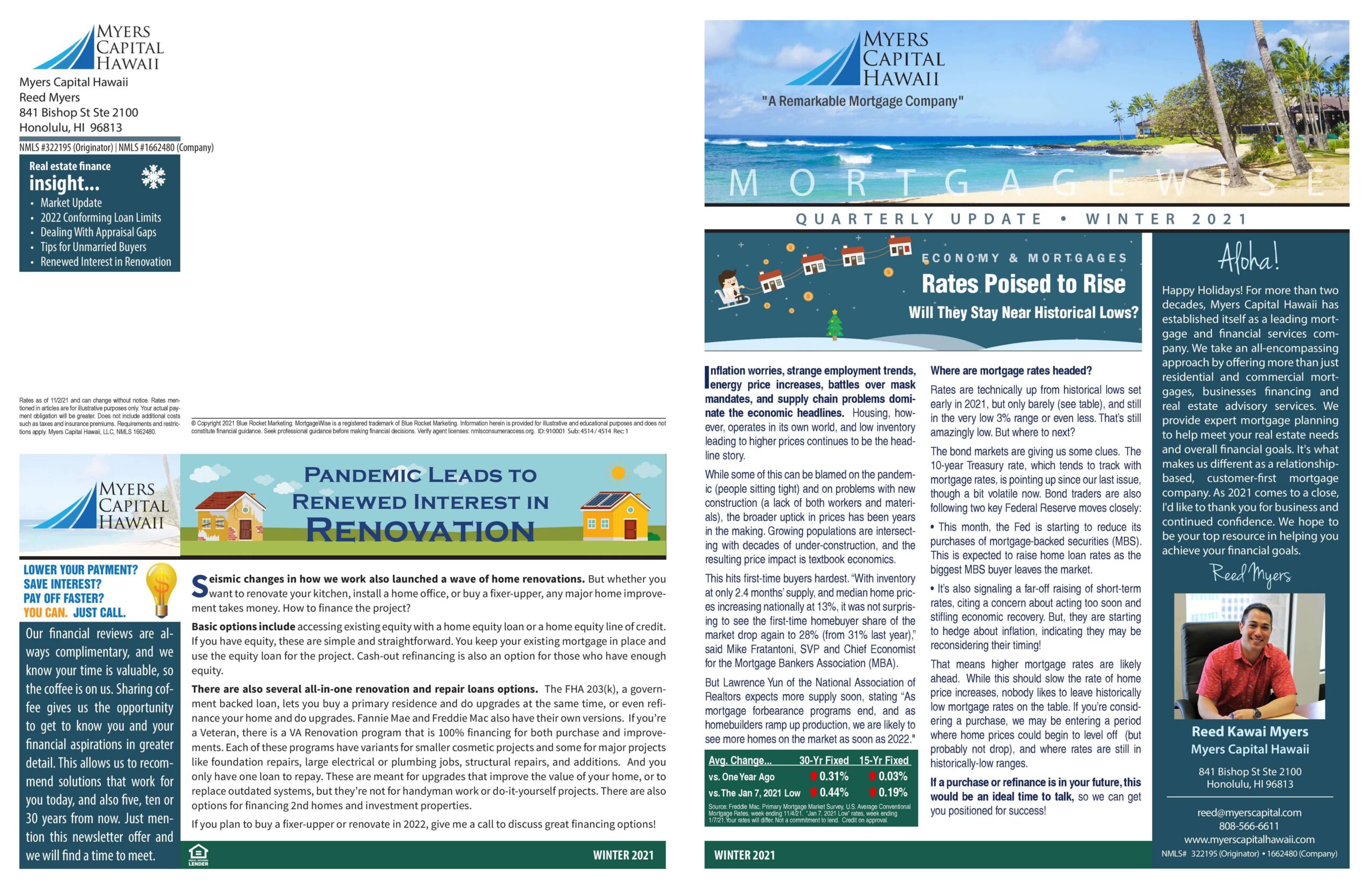
    ECONOMY & MORTGAGES: Will Rates Stay Near Historical Lows?

    Inflation worries, strange employment trends, energy price increases, battles over mask mandates, and supply chain problems dominate the economic headlines. Housing, however, operates in its own world, and low inventory leading to higher prices continues to be the headline story.

    While some of this can be blamed on the pandemic (people sitting tight) and on problems with new construction (a lack of both workers and materials), the broader uptick in prices has been years in the making. Growing populations are intersecting with decades of under-construction, and the resulting price impact is textbook economics.

    This hits first-time buyers hardest. “With inventory at only 2.4 months’ supply, and median home prices increasing nationally at 13%, it was not surprising to see the first-time homebuyer share of the market drop again to 28% (from 31% last year),” said Mike Fratantoni, SVP and Chief Economist for the Mortgage Bankers Association (MBA).

    But Lawrence Yun of the National Association of Realtors expects more supply soon, stating “As mortgage forbearance programs end, and as homebuilders ramp up production, we are likely to see more homes on the market as soon as 2022.”

    Where are mortgage rates headed? Rates are technically up from historical lows set early in 2021, but only barely (see table), and still in the very low 3% range or even less. That’s still amazingly low. But where to next?

    The bond markets are giving us some clues. The 10-year Treasury rate, which tends to track with mortgage rates, is pointing up since our last issue, though a bit volatile now. Bond traders are also following two key Federal Reserve moves closely:

    • This month, the Fed is starting to reduce its purchases of mortgage-backed securities (MBS). This is expected to raise home loan rates as the biggest MBS buyer leaves the market.

    • It’s also signaling a far-off raising of short-term rates, citing a concern about acting too soon and stifling economic recovery. But, they are starting to hedge about inflation, indicating they may be reconsidering their timing!

    That means higher mortgage rates are likely ahead. While this should slow the rate of home price increases, nobody likes to leave historically low mortgage rates on the table. If you’re considering a purchase, we may be entering a period where home prices could begin to level off (but probably not drop), and where rates are still in historically-low ranges. If a purchase or refinance is in your future, this would be an ideal time to talk, so we can get you positioned for success!

    Copyright © 2021 Myers Capital Hawaii

  • Mortgage Newsletter – Winter 2021

    Mortgage Newsletter – Winter 2021

    Get the latest mortgage industry news. Click here.

    – Economy and Mortgages: Rates Poised to Rise. Will They Stay Near Historic Lows?
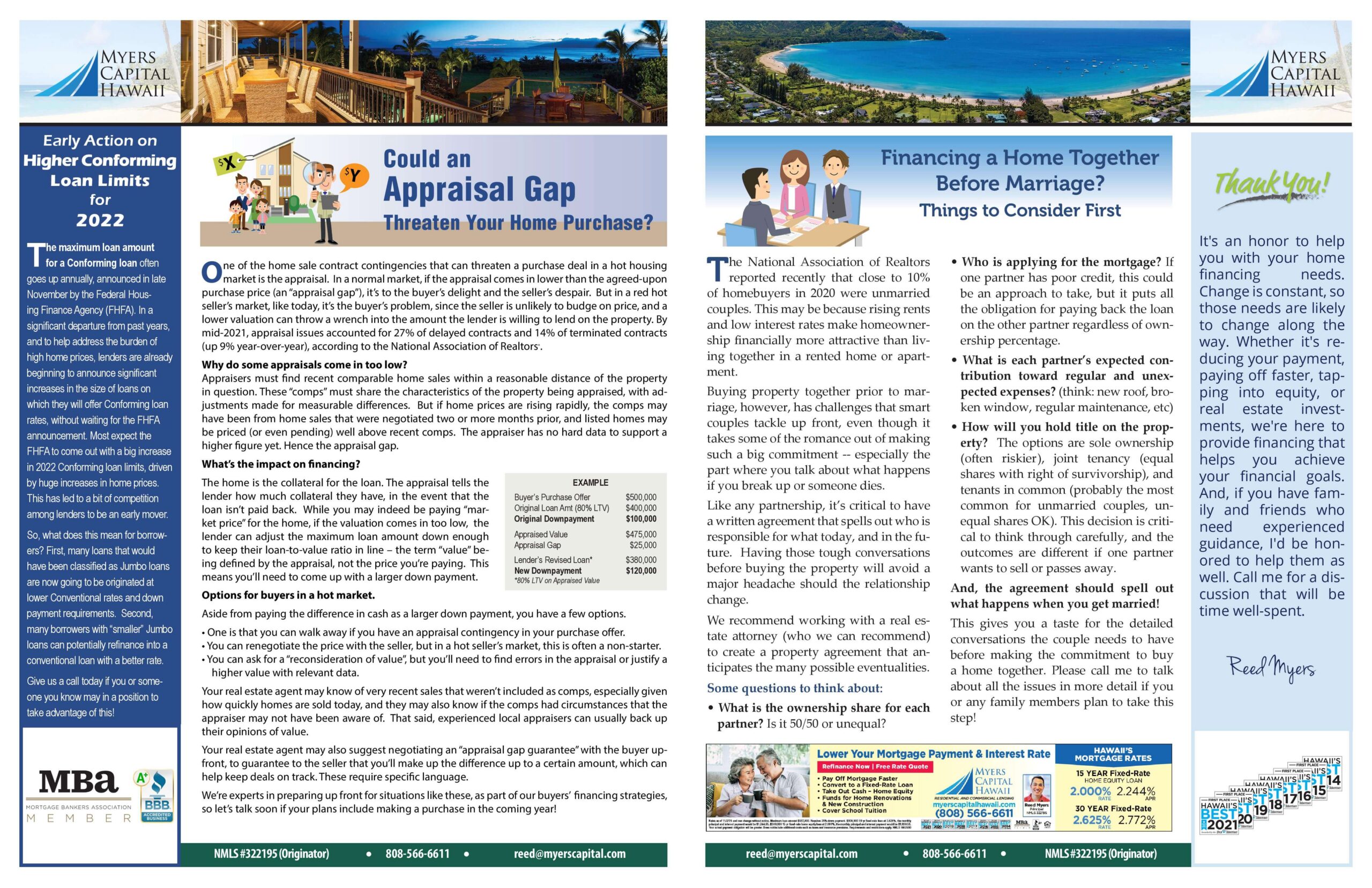
    – Early Action on Higher Conforming Loan Limits for 2022. What this means for borrowers.  
    – Could an Appraisal Gap Threaten Your Home Purchase? Find out how to deal with this issue.
    – Financing a Home Together Before Marriage? 5 Things to Consider First.
    – Pandemic Leads to Renewed Interest in Renovation. How to finance your project?

    Copyright © 2021 Myers Capital Hawaii


  • Holiday Food Drive – November 2021

    Holiday Food Drive – November 2021

    Myers Capital Hawaii (MCH) is holding a food drive throughout the month of November to collect non-perishable food to help Hawaii’s needy families. The company has partnered with the Hawaii Foodbank to host an onsite and virtual food drive.

    Did you know that 1 in 4 children are struggling with hunger in Hawaii, according to the Hawaii Foodbank? The COVID-19 pandemic has also increased food insecurity (the inability to provide sufficient food to all household members) in Hawaii by a whopping 50%. This food drive is an opportunity to help and give back to Hawaii communities in which we do business and call home.

    Our goal is to collect a combined total of $5,000 in monetary and food donations. (Each non-perishable food can/item will be counted as $2 towards this goal.) The company will match the first $300 in donations.

    HOW TO DONATE?
    It’s easy to participate. Donations are accepted through November 30, 2021:

    Online – Monetary Donations
    – Visit the MCH-Hawaii Foodbank site or click the link below:

    -Text VFD167 to 71777
    -Scan the QR code:

    Cash or Checks
    Checks: Make checks payable to “Hawaii Foodbank” and add “Myers Capital Hawaii” to the memo section.
    Drop off your check at either 1) Myers Capital Hawaii, 841 Bishop Street, Suite 2100; or 2) Hawaii Foodbank, 2611 Kilihau Street.

    Cash: Drop off at the Hawaii Foodbank and mention “Myers Capital Hawaii Food Drive.”

    In-Person
    Visit our office at 841 Bishop Street, Suite 2100. Hours: Weekdays, 8:30 a.m. to 5:30 p.m.
    Non-perishable food items and checks payable to the “Hawaii Foodbank” are accepted.

    Mahalo for your participation and support of the Hawaii Foodbank and our island families. Myers Capital Hawaii wishes you and your families a safe, happy holiday season. 

  • Should You Retain or Pay Off Your Mortgage in Retirement?

    Should You Retain or Pay Off Your Mortgage in Retirement?


    Should you keep a mortgage in retirement? The traditional answer has always been “pay it off and retire debt-free!” In 2021, though, the real advice is “it depends, and you have to do the math!”

    If your home equity is most of your retirement fund, and you can’t afford your current mortgage payments, you may have a few options:
    • If your mortgage rate is above 3.5%, a refinance could result in lower payments that you can afford, and allow you to stay in the home.

    • You could consider a reverse mortgage loan, which allows you to stay in the home and receive monthly cash payments or use it as a line of credit. Repayment is not due until the home is sold, the last borrower passes away or permanently leaves the home. The two most popular are the HECM loan (Home Equity Conversion Mortgage, insured by the FHA) and, for high-value homes, jumbo or proprietary reverse mortgages.

    • Alternately, you could sell the property, downsizing to a home and mortgage you can afford, or simply sell and live off the remaining equity (as a renter). If your home equity is most of your retirement fund, and payments are relatively small (or none), you could do a cash-out financing and tap into the equity to supplement your budget (which would then include a larger mortgage payment, of course).

    If you have retirement funds in addition to home equity, you may have more options:
    Refinance to today’s low rates (especially if your current rate is 3.5% to 4% or higher), giving you a lower payment each month.
    Downsize. Selling unlocks the equity, and you can use some to buy a new, smaller home.

    Seniors With Mortgages Now Quite Common
    While living debt-free is appealing, in our historically-low interest rate environment, it may make sense to keep the mortgage or take out a new loan to downsize rather than retire debt-free—especially if you can find yields on your investments which exceed your mortgage rate.

    And yes, retirees can get home loans! Withdrawals from retirement accounts, pension payments and Social Security all are income that could help you qualify.

    It is better to make plans before you retire, and there’s no time like the present.

    Contact us for a no-obligation mortgage planning session to get information on options that best fit with your retirement goals.

    Copyright © 2021 Myers Capital Hawaii

  • Mortgage Newsletter – Fall 2021

    Mortgage Newsletter – Fall 2021

    Get the latest mortgage industry news. Click here.

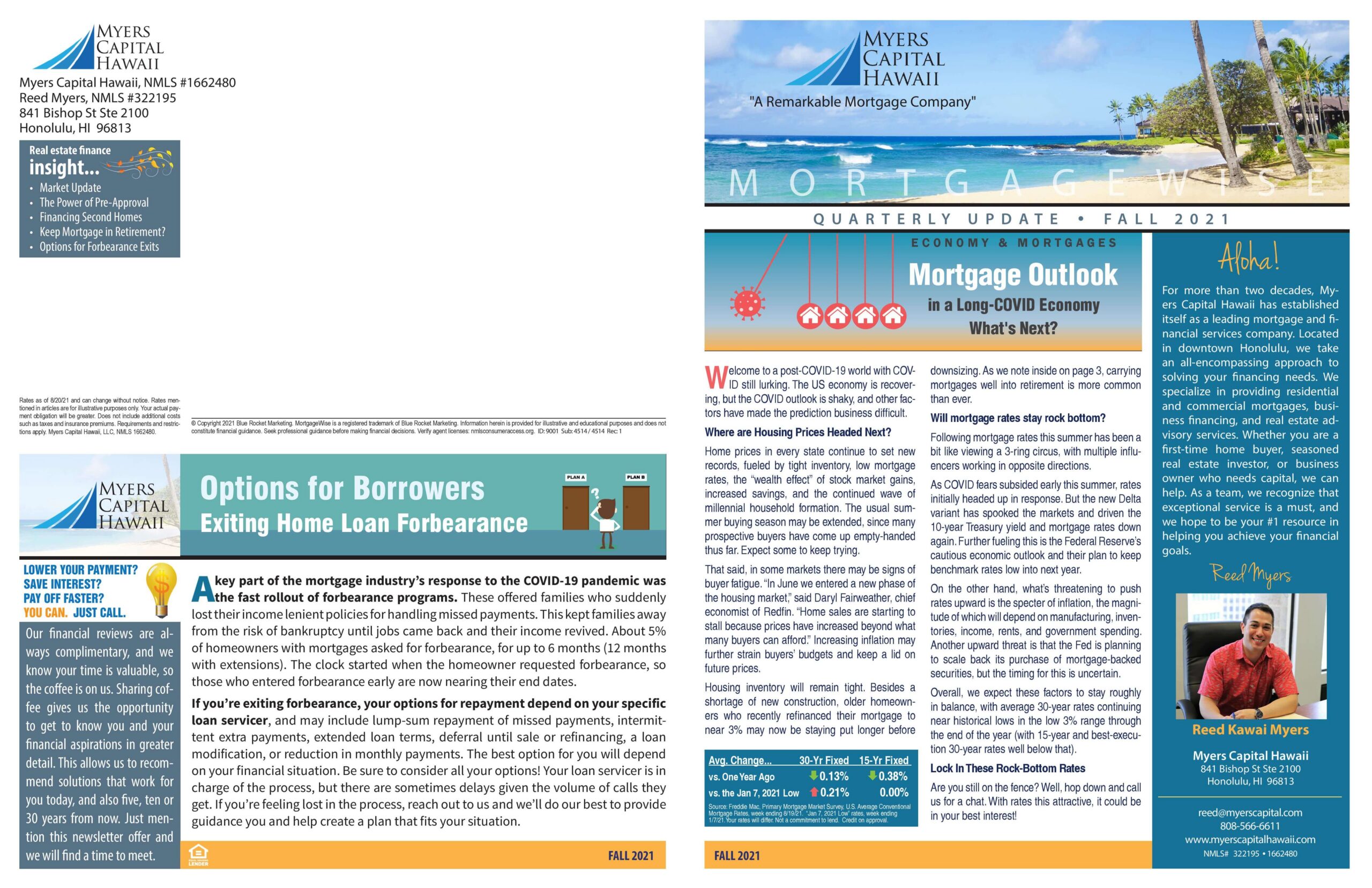
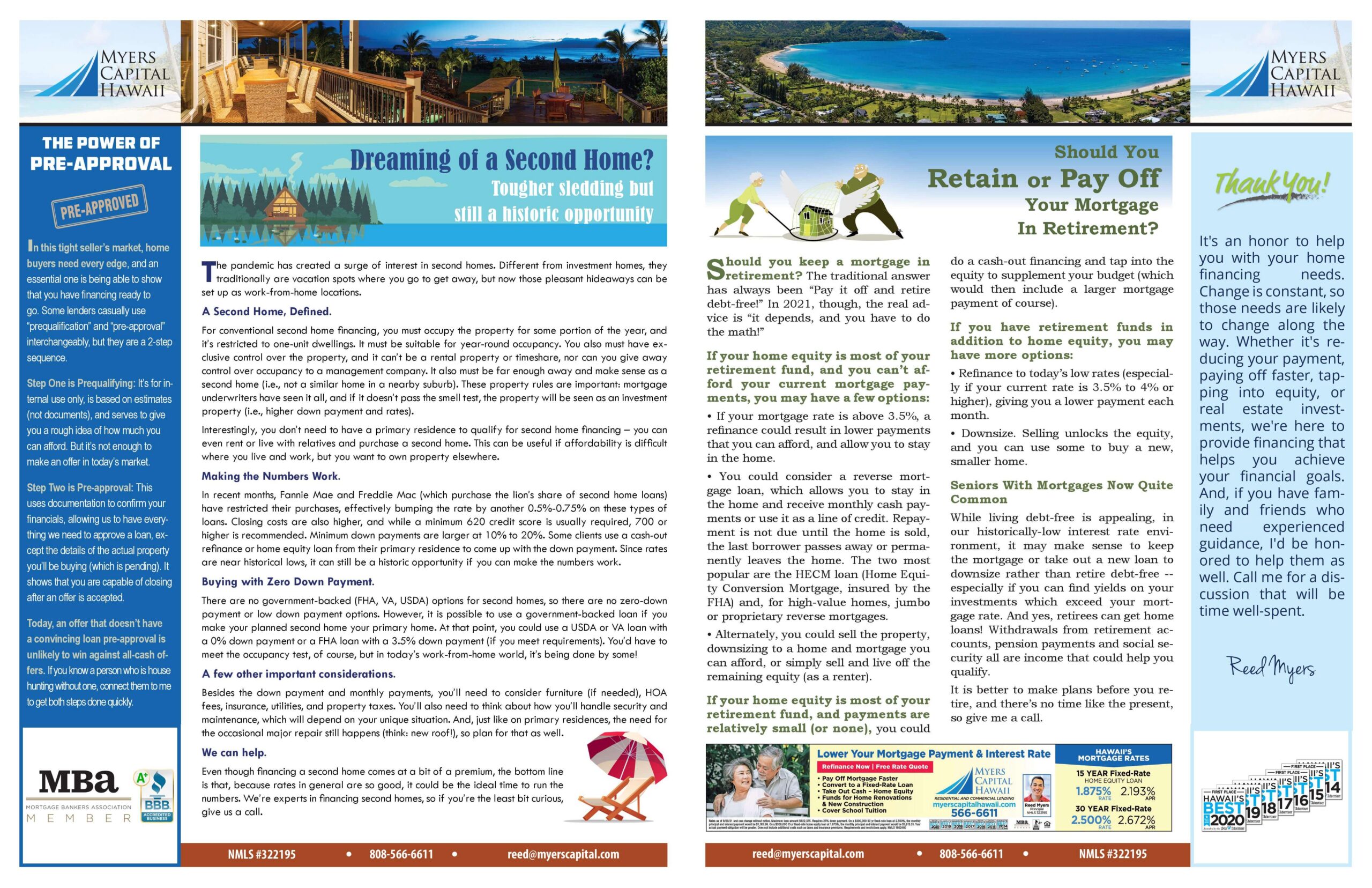
    – Mortgage Outlook in a Long COVID Economy. What’s next?
    – The Power of Pre-Approval. Why it’s important in a sellers market?
    – Ins and Outs of Second Home Financing.
    – Should You Retain or Pay Off Your Mortgage in Retirement?
    – Options for those Exiting Mortgage Forbearance.  

    Copyright © 2021 Myers Capital Hawaii