Category: Uncategorized

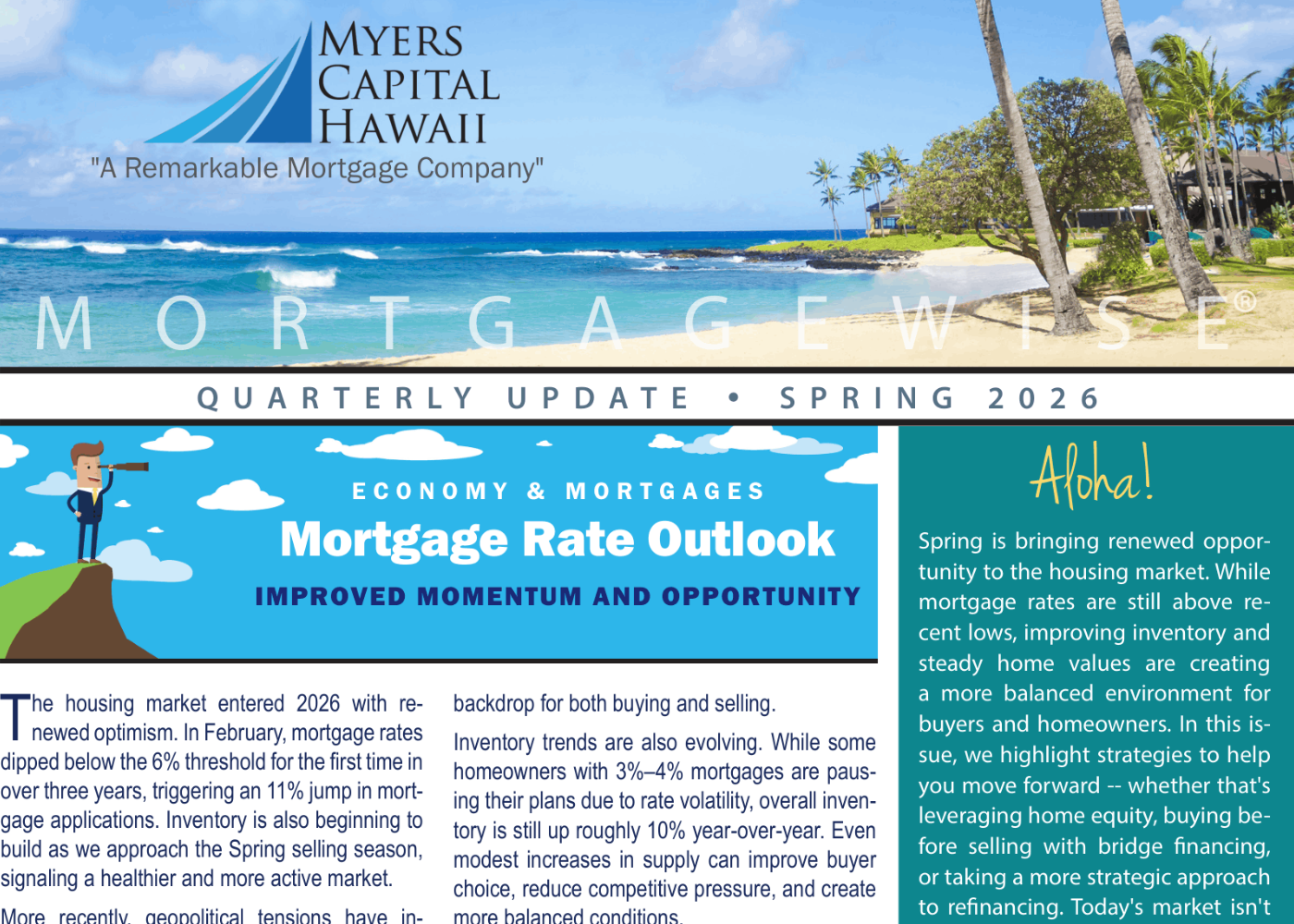
  • MortgageWise Newsletter – Spring 2026

    MortgageWise Newsletter – Spring 2026

    Mortgage News and Updates – Spring 2026
    Get the latest mortgage industry news. CLICK HERE.

    -Economy & Mortgages: Mortgage Rate Outlook: Improved Momentum and Opportunity  
    -Put Your Home Equity to Work
    -Buying Before Selling: The Modern Bridge Strategy  
    -Refinancing in 2026: It’s Not Just About the Rate
    -Waiting for the Perfect Mortgage Rate?  

    Economy & Mortgages: Mortgage Rate Outlook: Improved Momentum and Opportunity  

    The housing market entered 2026 with renewed optimism. In February, mortgage rates dipped below the 6% threshold for the first time in over three years, triggering an 11% jump in mortgage applications. Inventory is also beginning to build as we approach the Spring selling season, signaling a healthier and more active market.

    More recently, geopolitical tensions have introduced some uncertainty, pushing mortgage rates back up into the low-6%’s. While that has tempered some of the early momentum, it hasn’t changed the broader trajectory. Today’s rate environment remains meaningfully improved from the highs of the past two years, and demand continues to respond when conditions improve.

    Looking ahead over the next six months, mortgage rates are expected to remain relatively “sticky” in the low 6%’s. Inflation risks—driven in part by energy prices moving back above $100 per barrel—may limit how quickly rates decline, and the Federal Reserve has taken a cautious,  data-driven stance. Where we thought we might see the Fed lower the Fed Funds Rate two more times this year, now that’s looking unlikely (unless we see a recession). That said, even a stable rate environment provides a more predictable backdrop for both buying and selling.

    Inventory trends are also evolving. While some homeowners with 3%–4% mortgages are pausing their plans due to rate volatility, overall inventory is still up roughly 10% year-over-year. Even modest increases in supply can improve buyer choice, reduce competitive pressure, and create more balanced conditions.

    Home price growth is expected to remain modest, likely in the 1%–2% range nationally. However, the market continues to vary by region. Parts of the Sun Belt and West—where new construction has been more active—are seeing some price softening, while supply-constrained markets in the Northeast and Midwest continue to show resilience and firm pricing.

    There are, of course, uncertainties that could influence the path forward—from global events to Federal Reserve policy, leadership changes, and broader economic shift. But housing has consistently shown an ability to adapt. Strong homeowner equity, steady underlying demand, and long-term supply constraints continue to provide meaningful support.

    In summary, this is not a stalled market – it’s a gradually transitioning one. While short-term volatility may persist, the foundation remains solid. With the right strategy, both buyers and homeowners can move forward with confidence and take advantage of opportunities as they arise.Myers Capital Hawaii

    Put Your Home Equity to Work

    If you’ve owned your home for a while, you may be sitting on substantial equity. Here are five ways to put it to work

    Eliminate Mortgage Insurance: If your loan-to-value has dropped below 80%, you may be able to remove PMI instantly lowering your monthly payment.

    Home Improvements: Strategic upgrades like kitchens, bathrooms, or energy-efficient features can enhance your lifestyle while boosting long-term value.

    Consolidate High-Interest Debt: Replacing credit cards or personal loans with lower-rate financing can reduce interest costs and improve cash flow.

    Bridge to Your Next Home: Equity can help fund your next purchase before selling your current home (see the article to the right for another idea).

    Create a Financial Safety Net: A home equity line can provide flexible access to funds when needed, often with minimal cost to maintain.

    Every situation is unique. Contact us to discuss structuring your equity in a way that supports your goals.

    Buying Before Selling: The Modern Bridge Strategy

    Imagine, one day you happen to stumble upon the home of your dreams, and there’s a For Sale sign out front. Now, you’re facing the classic catch-22: you’re still living in your current home, and you need the equity from it to make the down payment on the dream home. Waiting until it sells could mean missing the opportunity.

    That’s Where a Bridge Strategy Comes In

    A bridge loan is short-term financing that allows you to access your home equity before your current property sells. These loans are typically structured for 6–12 months, often with interest-only payments to keep costs manageable. The goal is simple: give you the liquidity to purchase your next home, then pay off the bridge loan once your current home sells.

    The bridge strategy helps you avoid the problems associated with selling first, then buying—settling for what’s on the market once your current home sells, or moving everything into a rental while you wait for the perfect home to come along.

    A Variety of Strategies

    Bridge financing comes in various flavors, in the form of short-term loans, financing to be able to make a cash-backed offer without selling your current home, or to buy now and refinance later. In most cases, the bridge loan is sized to cover the equity you’ve built—often used for the down payment, and in some structures, to even pay off your existing mortgage. All are designed to let you buy first, then sell second.

    What if You Don’t Secure the New Home?

    Bridge financing is typically arranged alongside a specific purchase plan. If you don’t end up going under contract, the bridge loan usually isn’t finalized or funded, or it’s extendable for a fee—so you’re not taking on debt unnecessarily. The strategy is designed to activate when you’re ready to move forward.

    What If Your Current Home Takes Longer to Sell?

    Bridge loans are designed with time in mind, but it’s important to plan for this scenario. Most include a built-in time window (commonly up to 12 months), and pricing strategies on your current home can help ensure a timely sale. In addition, many borrowers have flexibility to adjust—whether that means making payments for a longer period, refinancing, or modifying the plan if needed. The key is building in a margin of safety upfront.

    Bridge Loans vs. HELOCs: A Key Difference

    Why not use a home equity line of credit instead? When it comes down to qualification. With a HELOC, lenders must count your current mortgage, the HELOC payment, and the new home payment, all at once. Bridge loans are often underwritten differently. Because they are tied to the sale of your current home, lenders can exclude that existing payment. Instead, qualification is typically based on the new home payment plus the bridge loan.

    The Bottom Line

    Bridge strategies give homeowners flexibility, leverage, and control over timing. Instead of rushing to sell or missing out on the right home, you can move forward with a plan. If you’re considering a move, a quick review of your equity and options can help determine whether a bridge strategy is the right fit.

    Refinancing in 2026: It’s Not Just About the Rate

    Refinancing is often viewed through one lens: interest rates. But today, it’s better understood as a strategic tool, one that can reshape your financial picture and align your mortgage with your long-term goals. With many homeowners holding low rates from recent years, refinancing decisions now go beyond “Is my rate lower?” to a more important question: What does this accomplish for me?

    Accelerating Financial Freedom

    For some homeowners, the goal isn’t a lower payment. It’s a faster path to being debt-free. Shortening your loan term—from 30 years to 15 or even 10—can significantly reduce total interest paid while accelerating equity growth. This strategy can position you to own your home outright ahead of major life transitions like retirement or career changes.

    Consolidating Higher-Cost Debt

    Mortgage financing is often among the lowest-cost debt available. A refinance can allow you to consolidate higher-interest obligations, such as credit cards or personal loans—into a single, more manageable payment. This can improve monthly cash flow, simplify finances, and reduce overall interest costs, freeing up resources for savings or investment.

    Optimizing Monthly Cash Flow

    In other cases, the goal is flexibility. Refinancing into a longer-term loan can reduce required monthly payments, creating room in the budget for other priorities—whether that’s starting a business, funding education, or adjusting to a change in income. Additionally, rising home values may allow you to eliminate mortgage insurance, creating immediate monthly savings without relying on a lower interest rate.

    Investing in Your Home…and Your Future

    Refinancing can also be used to access equity for renovations or improvements. Beyond enhancing day-to-day living, these upgrades can help protect and increase the long-term value of your home. For many homeowners, this is an alternative to moving—allowing the home to evolve with changing needs.

    In today’s environment, refinancing is less about reacting to rates and more about making intentional financial decisions. A well-structured refinance can improve cash flow, reduce long-term costs, or create new opportunities—depending on your goals.

    A quick review can help determine whether refinancing—or simply staying the course—is the right move for you.

    Waiting for the Perfect Mortgage Rate?

    Waiting for rates to fall below 6% before starting your home search? You might be waiting awhile longer, and recent events are a reminder of how unpredictable that strategy can be. After briefly dipping, mortgage rates have moved back up into the low 6% range, highlighting how quickly conditions can change.

    Waiting Often Costs More

    When rates eventually decline, demand tends to surge as sidelined buyers re-enter the market. That increased competition often pushes home prices higher, offsetting much of the benefit of a lower rate.

    Timing the market is also difficult. As we’ve seen, global events and economic data can shift rates quickly, making it hard to predict when the “right” moment will arrive. And while inventory has improved, the right home that truly fits your needs still doesn’t stay available for long.

    The Built-In Flexibility

    Mortgage financing offers an important advantage: flexibility. If rates decline meaningfully in the future, refinancing may allow you to capture a lower rate later. What you can’t change is the purchase price of the home you pass up today.

    The goal isn’t to perfectly time interest rates — it’s to secure the right home with a payment that works for you. With the right strategy, you can move forward confidently today while still keeping options open for tomorrow. That’s what we’re here to help with.

    Copyright © 2026 Myers Capital Hawaii

  • Mortgage Rate Outlook: Improved Momentum and Opportunity

    Mortgage Rate Outlook: Improved Momentum and Opportunity

    The housing market entered 2026 with renewed optimism. In February, mortgage rates dipped below the 6% threshold for the first time in over three years, triggering an 11% jump in mortgage applications. Inventory is also beginning to build as we approach the Spring selling season, signaling a healthier and more active market.

    More recently, geopolitical tensions have introduced some uncertainty, pushing mortgage rates back up into the low-6%’s. While that has tempered some of the early momentum, it hasn’t changed the broader trajectory. Today’s rate environment remains meaningfully improved from the highs of the past two years, and demand continues to respond when conditions improve.

    Looking ahead over the next six months, mortgage rates are expected to remain relatively “sticky” in the low 6%’s. Inflation risks—driven in part by energy prices moving back above $100 per barrel—may limit how quickly rates decline, and the Federal Reserve has taken a cautious,  data-driven stance. Where we thought we might see the Fed lower the Fed Funds Rate two more times this year, now that’s looking unlikely (unless we see a recession). That said, even a stable rate environment provides a more predictable backdrop for both buying and selling.

    Inventory trends are also evolving. While some homeowners with 3%–4% mortgages are pausing their plans due to rate volatility, overall inventory is still up roughly 10% year-over-year. Even modest increases in supply can improve buyer choice, reduce competitive pressure, and create more balanced conditions.

    Home price growth is expected to remain modest, likely in the 1%–2% range nationally. However, the market continues to vary by region. Parts of the Sun Belt and West—where new construction has been more active—are seeing some price softening, while supply-constrained markets in the Northeast and Midwest continue to show resilience and firm pricing.  

    There are, of course, uncertainties that could influence the path forward—from global events to Federal Reserve policy, leadership changes, and broader economic shift. But housing has consistently shown an ability to adapt. Strong homeowner equity, steady underlying demand, and long-term supply constraints continue to provide meaningful support.

    In summary, this is not a stalled market – it’s a gradually transitioning one. While short-term volatility may persist, the foundation remains solid. With the right strategy, both buyers and homeowners can move forward with confidence and take advantage of opportunities as they arise.

    Get the latest mortgage industry news. CLICK HERE.

    Copyright © 2026 Myers Capital Hawaii

  • 2026 Conforming and FHA Loan Limits Jump 3.26%

    2026 Conforming and FHA Loan Limits Jump 3.26%

    The Federal Housing Finance Agency (FHFA) has announced the new conforming loan limits for 2026 on residential mortgages acquired by Fannie Mae and Freddie Mac. These higher limits reflect continued home price appreciation over the past year.

    The new baseline loan limit for one-unit properties will be $832,750, representing a $26,250 increase over 2025.

    In high-cost areas such as Hawaii and Alaska—where 115% of the local median home value exceeds the baseline—loan limits are adjusted higher. For 2026, the maximum loan limit in these areas will be $1,249,125, or 150% of the baseline limit.

    FHFA 2026 Limits

    Number of Units
    Baseline Limits
    High-Cost Area Limits
    One
    $832,750
    $1,249,125
    Two
    $1,066,250
    $1,599,375
    Three
    $1,288,800
    $1,933,200
    Four
    $1,601,750
    $2,402,625


    FHA 2026 Limits

    Number of Units
    Low-Cost Area “Floor”
    High-Cost Area “Ceiling
     

    Alaska, Hawaii, Guam, and U.S. Virgin Islands “Ceiling”

    One
    $541,287
    $1,249,125
    $1,873,625
    Two
    $693,050
    $1,599,375
    2,399,050
    Three
    $837,700
    $1,933,200
    $2,899,800
    Four
    $1,042,125
    $2,402,625
    $3,603,925

    By law, both FHFA and FHA adjust loan limits annually to reflect changes in U.S. home prices. For 2026, conforming loan limits increased by 3.26%, based on the FHFA House Price Index, which measures the average change in home values between the third quarters of 2024 and 2025.

    For more details:

    1. FHFA Conforming Loan Limits. Click Here  
    2. FHA Loan Limits: Click Here


    Benefits of Higher Loan Limits

    Home Buyers

    Lower Monthly Payment and Overall Loan Costs
    Purchasing a home with a conforming loan versus a higher-cost jumbo loan can lower your borrowing costs. Conforming loans generally have better interest rates, lower costs, and flexible down payment, credit, and qualification guidelines.

    Increased Purchasing Power
    Qualify for a larger loan to purchase a better home—whether that means a remodeled kitchen, an extra bedroom, more space, or a preferred location


    Homeowners 

    Access More Equity with a Cash-Out Refinance
    Leverage your home’s equity to pay down debt, cover college tuition, or fund home improvements.
    Refinance Out of a Jumbo Loan
    If your jumbo loan balance is near the new conforming limit in your area, refinancing to a conforming loan could help you secure better terms and lower costs.


    Explore Your 2026 Mortgage Options

    With higher loan limits in 2026, you have more flexibility with both conventional and FHA programs. Whether buying a primary home or growing your investment portfolio, now is a great time to see how these changes can benefit you. Call 808-566-6611 or request a consultation today.

    Copyright © 2026 Myers Capital Hawaii

  • Mortgage Rate Outlook: Gradual Improvement Continues

    Mortgage Rate Outlook: Gradual Improvement Continues

    As the 2026 forecasts roll out, one theme stands out: gradual but meaningful improvement. While headlines warn of everything from AI bubbles to economic shocks, the housing market looks comparatively steady—and increasingly predictable.

    Housing: Affordability Slowly Returns

    (Un-)Affordability has been the housing story of the last few years. Housing costs recently peaked at about 42% of median household income, far above the long-standing 30% rule of thumb. The good news is that pressure is easing. With home prices forecast to be roughly flat in 2026, affordability has room to recover. The price-to-income ratio peaked above 5.5x income in 2022, has fallen to about 5.3x, and is projected to dip below 5x next year. Truly balanced markets tend to sit closer to 4x income, so there’s still work to do—but the trend is in the right direction, especially if incomes continue to rise.

    Activity: The Lock-In Effect Is Fading

    Market activity should pick up in 2026 as the “lock-in” effect of 3% mortgages continues to fade. There are now more mortgages above 6% than at 3% or below, meaning more homeowners are willing to move. That points to more listings, better choices, and more balanced markets—all while homeowners still hold record levels of equity.

    Rates: They’ve Been Sticky. What’s Next?

    The Fed has cautiously trimmed short-term rates over the past 15 months, but mortgage rates haven’t followed as neatly. The most recent two Fed cuts (50 basis points) were followed by 10-year Treasury yields—closely tied to mortgage rates—actually rising by about 20 basis points. Why? The bond market is more concerned about inflation re-accelerating than the labor market weakening. With mixed data (and recent disruptions to jobs reporting), markets are firmly in waitand-see mode.
     
    Looking ahead, mortgage rates are expected to drift slowly into the low-6% range, with occasional dips below 6% driven by headlines. The Fed is likely to remain cautious and data-driven.

    Bottom Line

    All signs point to a much healthier environment for buyers in 2026: improving affordability, better inventory, more balanced pricing, and gradually easing rates. Momentum matters—and the trend may finally be your friend. If you’re planning a move soon or laying longer-term plans, now is a smart time to talk strategy and get positioned.

    Get the latest mortgage industry news. CLICK HERE.

    Copyright © 2026 Myers Capital Hawaii

  • MortgageWise Newsletter – Winter 2026

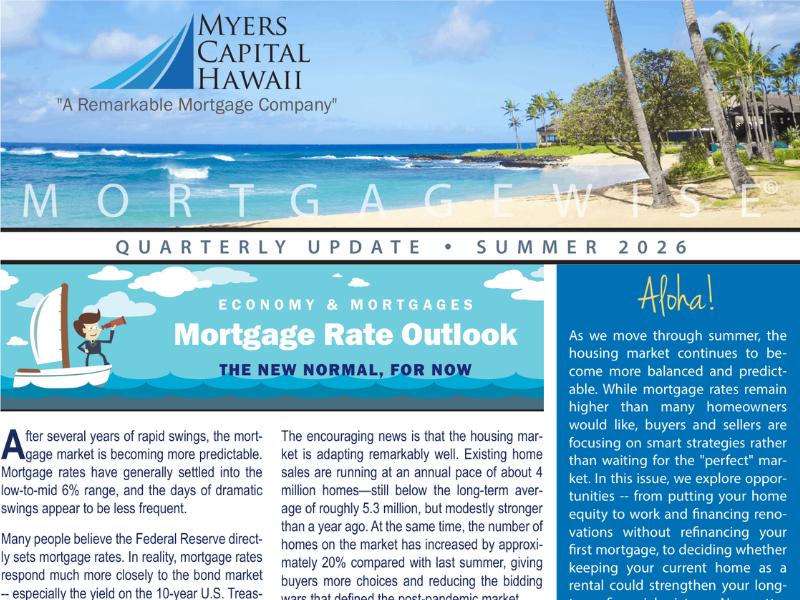
    MortgageWise Newsletter – Winter 2026

    Mortgage News and Updates – Winter 2026
    Get the latest mortgage industry news. CLICK HERE.
     
    -Economy & Mortgages: Mortgage Rate Outlook: Gradual Improvement Continues
    -2026 Conforming Loan Limits Increased!
    -Down Payment Strategy: Finding the Sweet Spot
    -Debt-to-Income Ratios: The Quiet Lever That Can Make or Break a Loan Application
    -Is the 50-year Mortgage a Good Idea?

    Economy & Mortgages: Mortgage Rate Outlook: Gradual Improvement Continues

    As the 2026 forecasts roll out, one theme stands out: gradual but meaningful improvement.
    While headlines warn of everything from AI bubbles to economic shocks, the housing market
    looks comparatively steady—and increasingly predictable.

    Housing: Affordability Slowly Returns (Un-)Affordability has been the housing story
    of the last few years. Housing costs recently peaked at about 42% of median household income,
    far above the long-standing 30% rule of thumb. The good news is that pressure is easing.

    With home prices forecast to be roughly flat in 2026, affordability has room to recover. The
    price-to-income ratio peaked above 5.5x income in 2022, has fallen to about 5.3x, and is projected
    to dip below 5x next year. Truly balanced markets
    tend to sit closer to 4x income, so there’s
    still work to do—but the trend is in the right direction,
    especially if incomes continue to rise.

    Myers Capital Hawaii

    myers capital hawaii

    2026 Conforming Loan Limits Increased!

    Adding another arrow in your homebuying quiver, conforming loan limits have once again increased in 2026. Reflecting rising home values and in support of its mission to expand homeownership opportunities, The Federal Housing Finance Agency (FHFA) announced in December that its new conforming loan limits would rise 3.26%, in line with the average increase in home prices in 2025. 

    The baseline limit rose to $832,750. High-cost markets in urban areas may now have a limit as high as $1,249,125. This is good news for mortgage financing, as these higher limits help homeowners secure better rates and terms, and it improves your buying power! Homes that previously may have required you to take out a jumbo loan may now be acquired more affordably. 

    And, if you were at the low end of the old Jumbo loan range, it may present an opportunity for you to refinance into a conforming loan with a more attractive rate. Give us a call to discuss!!

    myers capital

    Down Payment Strategy: Finding the Sweet Spot

    Down payments. When deciding how much to put down, it seems logical that bigger must be better—after all, a smaller loan, less mortgage insurance, and more equity sound appealing. But not so fast. With interest rates and home values easing, loan limits rising, and a wide range of loan programs offering different “sweet spots,” choosing the right down payment requires careful consideration and guidance from an experienced loan officer.

    Why Down Payment Size Matters. Your down payment directly affects the loan terms you may qualify for and how much liquidity you have after closing. It influences your monthly payment, potential mortgage insurance costs, and even loan pricing—specifically how many points you may need to pay to secure a given interest rate. 

    Look Deeper to Find the Sweet Spots. Loan-level pricing adjustments (LLPAs) are pricing brackets driven by factors such as loan-to-value (LTV), credit score, and other risk elements. In general, pricing improves as LTV drops. Many mortgage programs have clear LTV breakpoints where pricing improves meaningfully, creating true “sweet spots” for down payment strategy

    What to Look For: Sweet Spots Vary by Loan Type. With conventional loans (up to 97% LTV), 20% down (80% LTV) is the biggest inflection point: mortgage insurance disappears and pricing improves. At 25% down, there is often another meaningful improvement in pricing for a relatively small increase in cash, making it one of the best risk-adjusted sweet spots for borrowers who can reach it. For buyers putting 10–20% down, the sweet spot is often around 15%, where mortgage insurance costs commonly drop noticeably. 

    With FHA loans, pricing is largely flat regardless of down payment, and mortgage insurance is the primary factor. With as little as 3.5% down, borrowers pay both an upfront mortgage insurance premium and monthly insurance. FHA does not reward incremental down payment in pricing; the key sweet spot is 10% down, which causes monthly mortgage insurance to automatically end after 11 years. 

    VA loans are unique as well. There is no monthly mortgage insurance, and pricing is not closely tied to LTV. Instead, borrowers pay a VA funding fee, which decreases at 5% and 10% down. From a pricing perspective, there is little incentive to put money down beyond reducing the payment and funding fee. For most borrowers, the VA sweet spot is 0% down. 

    Jumbo loans vary a lot by investor, but typically require at least 20% down, with notable pricing improvements often occurring at 75% and 70% LTV. 

    Conclusion

    Many buyers assume they should put every available dollar into their down payment. In reality, reaching the right down-payment tier can improve pricing just as much—while preserving cash for furnishings, renovations, or savings. Contact me to discuss your next move, and we’ll help you strike the right balance between affordability and liquidity.

    ground up construction loans

    Debt-to-Income Ratios: The Quiet Lever That Can Make or Break a Loan Application

    Most buyers obsess over credit scores— and that makes sense. But here’s a little-known truth from inside underwriting: improving your debt-to-income ratio (DTI) by just a few points can matter as much as a 20–40 point credit score increase. 

    Why? Because DTI is the stress test. It’s how underwriters decide whether your income comfortably supports your new mortgage—or whether the loan feels tight, risky, or more expensive. I’ve seen buyers miss approval by a single car payment. I’ve also seen buyers unlock better rates or higher loan amounts by shaving just 2–3 points off their DTI. That’s how loans are actually approved. 

    Why DTI Cutoffs Matter

    DTI compares your monthly debt—credit cards, auto loans, student loans, and more— to your gross income. 

    Here’s what most consumers don’t realize: DTI works in bands, not on a smooth curve. Moving from 45% to 43% can turn a “refer” into an “approve,” lower mortgage insurance, improve pricing, or increase how much home you qualify for. Often, that shift comes from one targeted change. 

    Small Moves, Big Impact

    Once we calculate your true DTI baseline, opportunities usually appear. Paying a credit card below 30% utilization can lower the payment used in DTI and boost your credit score. Paying off one installment loan can be the difference between qualifying and not qualifying. Even eliminating $75–$100 per month can materially change the outcome.

    Beware of “Harmless” New Debt

    One of the most common mistakes buyers make is adding new monthly payments before applying. That zero-interest furniture deal or buy-now-pay-later plan? If it shows up as a payment, it hits your DTI. One small obligation can undo weeks of preparation.

    Income and Timing Matter Too

    DTI isn’t just about debt. Bonuses, overtime, and commissions can often be included with proper documentation, while job changes can affect how income is counted.

    Timing matters as well: paying down revolving debt 30–45 days before applying gives credit reports time to update—and keeping balances steady through underwriting is just as important.

    A strong DTI doesn’t just help you get approved. It can expand your options, improve pricing, and give you leverage as a buyer—especially when you know which small moves actually move the needle. Let’s start a conversation about yours, today!

    50 year mortgage

    Is the 50-year Mortgage a Good Idea? (Short answer: no)

    The 50-year mortgage idea occasionally resurfaces whenever affordability gets bad. The pitch is simple: stretch the loan, lower the payment. But the math—and the market—tell a very different story.

    On a $300,000 loan at 6.5%, a 30-year mortgage runs about $1,896/month*. A 50-year mortgage drops that to roughly $1,691—a savings of just $205. That modest relief comes at a steep cost. That 30-year loan costs about $383,000 in total interest. The 50-year loan? Nearly $715,000—almost double the interest cost of the 30-year loan!

    Equity is where the damage shows up. After 10 years, the 30-year loan has paid down about $46,000 in principal. The 50-year loan? Just $11,000. Now add reality. On a $375,000 home, typical 6% seller costs are about $22,500. That wipes out the entire $11,000 of equity from the 50-year mortgage—and then some—just to sell.

    There’s another reason these loans won’t fly. There isn’t a secondary market for debt with 50-year terms with slow paydown and higher risk. To make them work, investors would likely require a higher interest rate, erasing much of the payment benefit and worsening the already-stratospheric total cost. Similarly, other ideas being floated — portable or assumable mortgages — also have structural problems that make them highly unpalatable to investors.

    Bottom line: a 50-year mortgage trades long-term wealth for minimal short-term relief—and leaves homeowners exposed when it’s time to sell.

    *Example payment for illustrative purposes only. Does not include taxes, insurance, or other costs. Actual rate and terms may differ. Not a commitment to lend.


    Copyright © 2026 Myers Capital Hawaii


  • Private Mortgage Investing with Reed Myers | Nalu Finance Podcast

    Private Mortgage Investing with Reed Myers | Nalu Finance Podcast

    Myers Capital Hawaii

    In this episode of the Nalu Finance Podcast, Stefan Wagner interviews Reed Kawai Myers, Principal of Myers Capital Hawaii and Myers Investment Group. They discuss private mortgage and bridge loan investing, and examine why Hawaii is a uniquely attractive yet underbanked market.
    They explore how private lending operates outside of traditional banks, detailing how investors can access asset-backed mortgage opportunities. The episode covers expected returns, approaches to risk management, liquidity considerations, and the process when borrowers default.

    What’s Inside:

    ●How private mortgage lending works — how it differs from bank lending, why underwriting is asset-focused, and how first-lien real estate collateral protects investors.

    ●Why Hawaii is a unique private credit market — underbanked, relationship-driven, and shaped by local knowledge, culture, and conservative loan-to-value discipline.

    ●Risk, returns, and reality — how double-digit yields are generated, what semi-liquidity really means, and how experienced lenders manage defaults when things don’t go as planned.

    Why Listen:

    This episode is a practical deep dive into private mortgage investing, grounded in real-world experience rather than theory. Reed brings a disciplined, relationship-driven approach to lending that highlights both the opportunities and the responsibilities that come with offering alternative credit solutions.

    🎧 Listen Now On: Apple Podcasts | Spotify | Youtube | Podomatic

    Myers Capital

    Transcript:

    Intro: 00:01 Nalu FM Finance Podcast. Insight into the financial markets.

    Reed Myers: 00:10 To me, my clients, both my borrowers and my capital investors are everything that determines the health of your company, your credibility, everything. But we want to be aligned as far as our culture and what we can actually provide and what we can’t.

    Sponsor: 00:22 This podcast is powered by Vestr, the engine behind Active Management. Vesta is a Switzerland-based fintech startup that provides software for issuers of actively managed certificates to automate their value chain fully. Visit Vestr, V-E-S-T-R dot com to schedule a meeting with an expert and to learn more about Vestr.

    Stefan Wagner: 00:44 Welcome to the Nalu Finance Podcast. In this episode, we dive into the world of private mortgage and bridge loan investing, a space that blends real estate, lending, and income generations. Our guest is Reed Myers, principal and owner of Myers Capital Hawaii and Myers Investment Group, who has built a reputation for offering investors access to income-generating mortgage opportunities. Reed shares how private lending works, what makes Hawaii real estate market unique, and how investors can participate in these asset-backed strategies.

    We’ll discuss everything from risk management and default recovery to expected returns, liquidity, and who these opportunities are best suited for. Whether you’re an experienced investor or just curious about alternative income streams, this episode will give you a practical insight into how private mortgage investing really works. Reed, you have built Myers Capital into a specialist in private mortgage and real estate lending and Myers Investment Group as an investment management company offering passive mortgage investments. How did you first become involved in this space and what market gap did you identify? 

    Reed Myers: 01:53 Great question and thanks for having us on the podcast. I first got started in real estate and finance out of college actually. So I got recruited to work for a small real estate investment trust in the Carolinas. And so that was kind of my first foray into real estate, finance, some development. And then shortly after that, we came on board with my family company, Myers Capital. My father started in 1998. At the time, we were just a very small, still small today for many respects, but commercial mortgage banker, primarily doing commercial lending for small apartment buildings, mixed use, things like that throughout the Carolinas and the Southeast. So I actually started off loan processing, doing some underwriting, the basics.

    Stefan Wagner: 02:46 Yeah, but that way you learn what to look for. When it comes your way, you can probably very quickly spot certain patterns that you would have never known if you would have not done that.

    Reed Myers: 02:56 Yeah, exactly.

    Stefan Wagner: 02:58 So for the listeners less familiar, what exactly is actually private mortgage lending and how does it differ from traditional bank lending?

  • Mortgage Newsletter Fall 2025

    Mortgage Newsletter Fall 2025

    Mortgage News and Updates – Fall 2025
    Get the latest mortgage industry news.
    CLICK HERE.

    -Economy & Mortgages: Mortgage Rate Outlook: A More Buyer-Friendly Market
    -Is VantageScore Your Credit Comeback Story?
    -CRYPTO Meets Mortgages
    -10 Mortgage Moves to Tame Today’s Rates
    -Rates are Down! Is it Time to Refinance?

    Economy & Mortgages: Mortgage Rate Outlook: A More Buyer-Friendly Market

    Two years ago, real estate was a sprint—record-low rates, surging demand, and bidding wars. Homes closed in days, often with inspections waived; buyers rushed or risked being priced out.

    Now the script has flipped. With higher rates, demand has cooled and the market has found balance. Joel Berner, Senior Economist at Realtor.com, calls today a “buyer-friendly balanced market.”

    Is VantageScore Your Credit Comeback Story?

    Credit scoring often feels like a locked vault. A mysterious process that most consumers don’t understand, and no alternative way to measure your creditworthiness.

    If your FICO score is nonexistent or less than ideal, it can keep you from homeownership, or from getting a better interest rate on your next loan.

    Enter VantageScore Solutions, an independent company formed in 2006 by Equifax, Experian, and TransUnion to give lenders—and consumers—an alternative to FICO.

    The latest version—VantageScore 5.0, rolled out in 2025—introduces new “GAIN Attributes,” analyzing recent credit behavior over 24 months to boost predictive power. Compared to older versions, it can score millions more Americans with limited history and reduce the frustrating score swings we sometimes see across the three bureaus.

    Here is the good news:

    More people get scored. Traditional FICO models won’t even generate a score unless you’ve had a credit account open and active for at least six months. By contrast, VantageScore can create a score if you’ve had just one account reported at any point in the past two years. That means millions more people—especially those with new or “quiet” credit files—can finally be scored.

    Alternative data counts. Rent, utility, and telecom payments can be included when reported—recognizing financial habits often invisible to other scoring systems. It can mean higher approval chances and potentially better rates—especially if you’ve been paying your bills but haven’t built up years of traditional credit history.

    Medical debt treated differently. Newer models give medical collections less weight, reducing unfair penalties for temporary hardships.

    Smarter on inquiries. Multiple credit checks for rate shopping (like mortgages) are treated as one, protecting your score while you compare.

    The industry is steadily adopting it. In July 2025, the Federal Housing Finance Agency (FHFA) formally allowed lenders to use VantageScore 4.0 (in addition to “Classic” FICO) for loans sold to Fannie Mae and Freddie Mac.

    This means many conforming mortgages (the bulk of the U.S. mortgage market) can now legally rely on VantageScore 4.0 in underwriting. Other programs still require FICO, and some require both. But, the door to better financing is gradually opening. Find out how this new model can potentially open some doors for you!

    Crypto Meets Mortgages

    Did you know your Bitcoin or Ethereum might one day help you qualify for a mortgage?

    In June, the Federal Housing Finance Agency (FHFA) directed Fannie Mae and Freddie Mac to begin preparing to recognize cryptocurrency investments as assets when assessing mortgage applicants. That’s a big shift: until now, crypto had to be converted into U.S. dollars before it could count toward your financial picture.

    While the details are still being worked out—and there are plenty of questions about volatility, liquidity, and how lenders will verify balances—this move signals that digital assets are stepping into the mainstream of housing finance.

    Imagine a world where your digital wallet carries weight alongside your checking and savings accounts!

    In the meantime, if you want to explore how today’s rules let you leverage your assets and put you in the strongest position to buy or refinance, let’s talk. That next home may be closer than you think!

    10 Mortgage Moves to Tame Today’s Rates

    With home prices still elevated and mortgage rates higher than we’d like, affordability is the elephant in every open house. But here’s the good news: buyers have more tools than ever to make the numbers work. These are some of the many strategies we are using with clients, in order to open doors—often literally:

    1) Polish That Credit Score. A score north of 740 is like VIP access to better rates and thousands saved over the loan’s life. Pay down debt, keep balances low, and hit pause on new credit cards until after closing. Check your score regularly; it’s never too early to start taking the right steps.

    2) Consider an ARM (Yes, Really). Adjustable-rate mortgages, which are fixed for 3, 5, 7, or 10 years, often start with lower rates than 30-year fixed loans. If you don’t plan to be in the house for a full 30 years, considering an ARM may be a really smart move.

    3) Go Bigger on the Down Payment. While not for everyone, 20% down not only avoids PMI, it shrinks your loan balance and can usually earn you a better rate and a smaller payment.

    4) Buy Points Like a Pro. Pay points upfront. Each point (1% of the loan amount) shaves about 0.25% off your rate. Stay put long enough for the monthly savings to pay back the upfront cost, and after that, the long-term savings can be really attractive. Let us run the numbers and show you.

    5) Marry the House, Date the Rate. Find the right home now, refinance later. While future rates are not guaranteed, you may not want to miss an opportunity because rates aren’t picture perfect.

    6) Negotiate Like You Mean It. Today’s sellers are more flexible. Closing costs, repairs, even temporary rate buydowns are back on the table. Ask—nicely, but firmly. Worry less about other bidders.

    7) Snag a Builder’s Buydown. Builders hate unsold homes. Many are offering flex cash that you can use in different ways. Skip the appliance upgrade and instead use it to fund a 2-1 buydown that chops your payment for the first couple years. We’ll run the math with you.

    8) Think Beyond Conventional. FHA, VA, USDA loans can deliver lower rates or looser requirements. For some buyers, these programs are the ticket to more-affordable financing.

    9) A Quick DTI Diet. Your Debt-to-Income ratio can directly affect your rate. Paying down credit cards or car loans before applying can free up room in the budget and unlock more attractive terms.

    10) Make Extra Payments (Say What?). If rates are higher than you’d like, the last thing you might think of is to make extra payments each month! But remember, extra principal payments – especially early in the life of a loan — can save huge amounts of interest over time. It’s akin to giving yourself a rate cut.

    A rough example: from a total interest cost standpoint, on a $300,000 loan at 6.5%, making just a 1% extra payment each month is akin to getting a 6.3% mortgage. And you pay off about 10 months earlier. Give that one some thought. Talk to us and we’ll show you.

    Bottom line: today’s market rewards creativity. There’s no single “right way” to finance a home, but there is a right way for you. With a little strategy, you can boost buying power, tame interest costs, and step confidently into that next home (or your first one!). Let’s talk about which of these moves fits your journey best!

    Rates are Down! Is it Time to Refinance?

    If you bought a home in the past few years, chances are your rate is close to 7%. Since then, rates have dropped enough that it may be worth exploring a refinance. The math isn’t one-size-fits-all, but that’s where we come in.

    We’ll look at closing costs, how long you expect to stay in your home, and whether resetting your loan term makes sense. Sometimes refinancing unlocks real monthly savings, even as it resets the clock.

    Or, it may allow you an opportunity to shorten the loan term (think 15-year loans), where you could be mortgage-free years sooner with thousands in mortgage interest saved. Credit scores matter too, and if yours could use a boost, we can create a plan together before you apply.

    Here’s a simple example*: on a 30-year fixed loan of $300,000, dropping the rate from 7% to 6% lowers the monthly principal-and-interest payment by nearly $200. That kind of savings could free up room in your budget every single month, and over the long run, it can add up to huge savings.

    A quick conversation can reveal whether refinancing makes sense for you today or whether it’s something for a bit later. There’s no cost to talk it through. Reach out to us when you have a few minutes, and let’s see what’s possible.

    *This is for illustrative purposes only and not a commitment to lend. Example does not include taxes, insurance, or other costs. Actual rates, payments, and savings will vary depending on your credit profile, loan terms, and market conditions.

    Copyright © 2025 Myers Capital Hawaii

  • Mortgage Rate Outlook: A More Buyer-Friendly Market

    Mortgage Rate Outlook: A More Buyer-Friendly Market

    Two years ago, real estate was a sprint—record-low rates, surging demand, and bidding wars. Homes closed in days, often with inspections waived; buyers rushed or risked being priced out.

    Now the script has flipped. With higher rates, demand has cooled and the market has found balance. Joel Berner, Senior Economist at Realtor.com, calls today a “buyer-friendly balanced market.”

    “[We see] a lot of sellers with some unrealistic expectations who list their homes maybe at prices they would have gotten in 2022, but it’s not 2022 anymore. So they have to do price reductions and negotiate with buyers.”

    It’s not a classic buyer’s market, but buyers have time for due diligence and leverage for repairs, credits, or closing costs. Instead of racing, we can align budget and long-term goals to structure the right path to ownership.

    For sellers, homes no longer “fly off the shelf.” Overpriced or fixer-upper listings sit. Homes need realistic pricing, curb appeal, and seller flexibility.

    What about rates ahead? Over the next 6-12 months, mortgage rates are expected to slide modestly lower — but with significant caveats. The key drivers are the Fed’s handling of short-term rates and how inflation and economic growth evolve. Although the Fed has begun trimming its policy rate, future cuts are expected to be measured and data-dependent, rather than aggressive. Bottom line, the Fed is in no hurry to get on the wrong side of either inflation or economic growth.

    Long-term rates, like mortgage rates, are not mechanically tied to the Fed rate. They reflect market expectations for inflation and growth, and they incorporate a term premium (extra yield for bearing interest rate risk over the long term).

    Even as the Fed cuts short term rates, the term premium could remain elevated if investors worry about the impact of inflation or economic growth. Many forecasters expect average 30-year fixed rates to end 2025 in the low 6’s, and gradually drift down as we go into 2026.

    While the slow slide in rates might tend to test one’s patience, there’s a silver lining: a large drop in rates would usher a flood of sidelined buyers into the market (and guess where home prices would then go). So the good news: for well-qualified buyers is that reduced competition, improving selection, and steady values have created one of the most favorable windows in years.

    If you’ve been waiting, now is the time to take the wheel. Let’s review your numbers, explore purchase or refinance options, and chart the course toward your long-term real estate goals.

    Get the latest mortgage industry news. CLICK HERE.

    Copyright © 2025 Myers Capital Hawaii



  • How Do Ground Up Construction Loans Work

    How Do Ground Up Construction Loans Work

    A Guide for Real Estate Investors

    Real estate investors have a broad range of opportunities in the current market. 

    Existing properties offer plenty of advantages in the right situations – no savvy real estate investor would deny that.

    New construction, designed with the preferences and demands of the local market in mind, can offer everything from more control and oversight to increased ROI from selling the property or renting it.

    Also, there are times when a new project that’s already broken ground or in the middle of construction that needs additional funding to reach its end. Completing the project and making sure it can create revenue is vital.

    For both new construction and in-progress projects that need some extra funding, construction loans are a key tool for real estate investors. These loans can maximize the ROI of the project through custom construction, which tailors the property to align with the wants and needs of the local housing market.

    So, how do construction loans work, and how can they support your goals as an investor? Let’s take a closer look.

    How Do Ground-Up Construction Loans Work? The Basics

    Even though the specifics can become complicated, as is often the case with many types of real estate loans, the basic idea behind construction loans is pretty simple.

    They are short-term loans used to cover the cost of the construction process. Construction loans can be used for new construction projects, rehabs of existing properties, and to provide the funding needed to complete in-progress work for either of these projects.

    The key benefit for real estate investors is the ability to change and improve one or many buildings in a way that aligns with the needs and desires of the local market, tapping into the specifics sought by that renters or buyers.

    The properties are often multi-family residences, but single-family homes developed as investment properties can use construction loans as well.

    These loans are short-term loans, intended to pay for the costs of construction. They are not permanent mortgages, but rather temporary financing designed specifically for the building phase.

    What Are Reimbursable Draws for Construction Loans?

    The money provided by a ground-up construction loan is generally disbursed as a series of draws as construction progresses, and not as a lump sum. The borrower pays for and completes the work, then the lender provides reimbursement.

    This process normally follows a draw schedule. In this structure, specific construction milestones are set. Once a milestone is reached, the contractor requests a draw, and the investor passes that request onto the lender.

    The lender then conducts a review to verify that the requested funds align with the completed work. Once approved, the lender disburses the funds and makes the related payments.

    Payments can generally start during the first 6-24 months after the loan is issued.

    GUC loans can have either monthly payments or interest reserves, where the lender funds the interest payments and adds it onto the loan.

    What are the Loan-to-Cost Ratio and Loan to After Repair Value for Construction Loans?

    The loan-to-cost (LTC) ratio is a relatively simple calculation that compares the project’s total cost to the amount financed through a construction loan. While a simple calculation, this ratio plays a crucial role in securing financing for the project.

    The LTC ratio is calculated by dividing the loan amount by the construction cost. The formula looks like this:

    – Loan Amount / Construction Cost = Loan-to-Cost Ratio

    Lenders generally look to finance projects where the LTC ratio is between 60-80% of the total project cost. Encouraging the investor to have a personal financial stake in the project – the remaining 20-40% of the total cost – is thought to encourage project completion and loan repayment.

    The desired 60-80% LTC ratio range is common but not always set in stone. Lenders may make exceptions for specific investors depending on their history in real estate investments, current financial position, and existing relationship with the lender.

    Loan-to-After-Repair-Value (LTARV) is a similar metric used as part of the lending process for renovations and repairs to existing properties. This calculation divides the expected and increased value of a project after repairs are completed by the value of the loan.

    A maximum LTARV of about 75% is common, although not set in stone. Loan providers want to ensure the investor has a financial commitment to encourage project completion and the repayment of the loan.

    What Do Construction Loans Cover?

    Construction loans can be used to pay for labor costs, materials, permitting, and the land itself (yes, a construction loan does include the land – or can, at least).

    The approval process is detailed and requires in-depth documentation from the investor. However, an approved construction loan will cover a wide range of costs related to the project.

    What are the Benefits of Construction Loans?

    The foundational benefit of a construction loan is to build a new property that taps into the wants and needs of the local housing market. Or, to renovate and repair an existing property so that it can better align with those wants and needs. A more desirable property can lead to a higher sale price or higher rents, improving ROI for the investor.

    Other key benefits of construction loans include their ability to cover all phases of the project with a single loan, making financing simpler for the investor. Crucially, these loans normally feature interest-only payments during active construction, providing financial flexibility over the course of the project.

    Some lenders also offer flexible loan term options and payment schedules to better support the changing timelines common in construction project.

    Managing the Costs of Construction Loans

    To address the cost of the loan, borrowers can:

    – Take out a construction loan that automatically converts to a mortgage at the end of its term.

    – Investor sells the property and pays off the construction loan.

    – Refinance into a long-term loan.

    – Pay off the balance in full with their own cash, which can be accomplished by selling the property.

    – On larger development projects with multiple phases, the construction loan could be modified to provide additional construction funds. In addition, on larger projects, some of the already built structures could be sold and used to pay down the loan.  

    – If the borrower can’t pay the full loan balance directly, they can secure long-term financing. This also helps to address the higher interest rates that often come with short-term loans like construction loans.

    What Happens After Construction is Completed?

    To address the cost of the loan after construction is completed, borrowers can:

    – Take out a construction loan that automatically converts to a mortgage at the end of its term.

    – Sell the property and pay off the construction loan with the proceeds.

    – Refinance into a long-term loan.

    – On larger development projects with multiple phases, the construction loan could be modified to provide additional construction funds. In addition, on larger projects, some of the already built structures could be sold and used to pay down the loan.  

    – If the borrower can’t pay the full loan balance directly, they can secure long-term financing. This also helps to address the higher interest rates that often come with short-term loans like construction loans.

    How to Qualify for a Construction Loan

    How hard is it to get a construction loan? The standards are higher than those of a conventional mortgage, for example, but are by no means impossible to meet for stable and established real estate investors.

    There are normally three major phases in the construction loan application process:

    1.    A pre-qualification phase that includes a builder assessment, where the lender determines if the builder attached to the project meets the lender’s standards.

    2.    Documentation submission and review, where the borrower submits detailed project information (such as budgets, project plans, and contracts with the builder) and the lender makes sure these documents align with their standards.

    3.    Approval, followed by the release of funds based on the project reaching defined construction milestones.

    What are the requirements for a construction loan? Exact details vary between lenders, but financial requirements relative to the loan amount are foundational. Lenders are less likely to offer loans to prospective investors who have inconsistent credit histories, significant outstanding debt, and other large financial obligations.

    Lenders also tend to require large down payments (often 20-25%) as well. Construction loans don’t have collateral to put on the line. So, the qualifications are stricter overall, and interest rates are higher than those seen with conventional mortgages.

    More unique requirements include the need for a qualified, licensed, and experienced builder to be part of the project.

    Borrowers will have to show they have a contract with the builder to complete the project. Additionally, deep details about the project itself are needed. That includes an in-depth breakdown of construction costs and pricing, the construction plans, the timeline, and more.

    Securing Your Construction Loan as a Real Estate Investor

    Construction loans require careful planning, assets that align with lender expectations, an established relationship with a qualified builder, and a detailed plan for the project.

    With those pieces in place, a construction loan can certainly pay off in the long run. Real estate investors can use the funds the loan provides to build attractive, durable, and dependable investment properties. That can mean long-term revenue from renters as well as a valuable asset within the investor’s portfolio.

    Looking for a construction loan lender? Myers Capital offers both ground-up and mid-construction lending options to get projects across the finish line and turn them into revenue-generating properties. Our approach includes no personal income verification, loan amounts up to $5 million, and the ability to transition to long-term financing.

    Myers Capital believes in forming true partnerships with our clients, providing guidance and advice to help them achieve their goals. Why? Because your success is our success.

    Learn more about our loans for commercial property investors.

    Copyright © 2025 Myers Capital Hawaii