Category: Uncategorized

  • Jumbo Loans are Back on Track in a Big Way

    Jumbo Loans are Back on Track in a Big Way


    For clients seeking to buy larger homes, and even for those hoping to buy a modest home in expensive markets, we have good news. Jumbo loans have returned as a viable option.

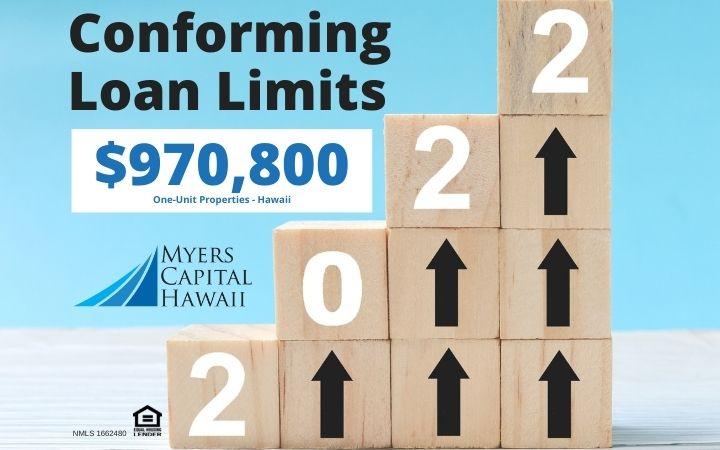
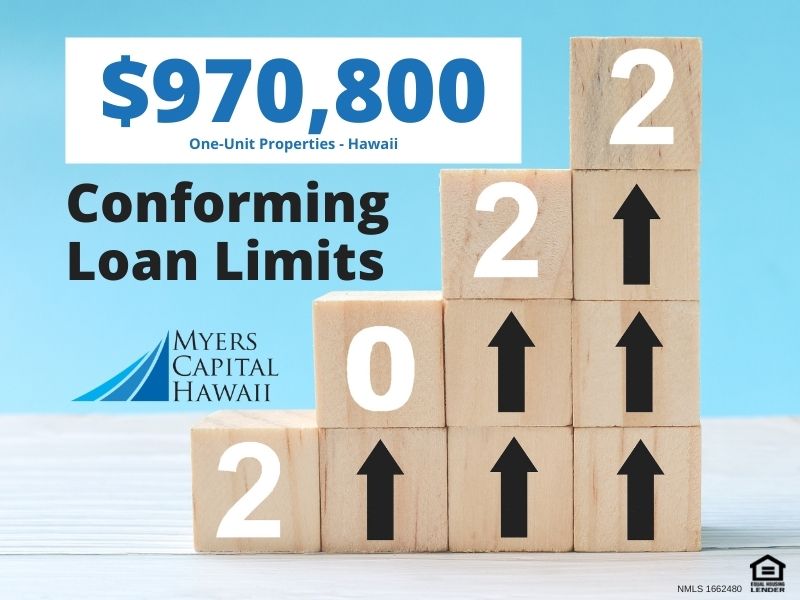
    If you need a mortgage larger than conventional loan limits ($822,375 in Hawaii, 2021) chances are now good we can get you the financing you need without paying a whole lot more in rate compared to a conventional loan.

    Jumbos for High-Credit Borrowers Offer Attractive Rates
    Lenders see the end of the pandemic tunnel, and their core audience for Jumbo loans actually came through the crisis in reasonable shape. These prospective borrowers stayed employed and had fewer expenses than normal. This allowed many to build assets. Now more are ready to buy. As such, the marketplace for these larger loans has grown.

    A persistent myth about Jumbo loans is that they are pricey. Not so. A borrower with good credit and a 20% down payment can currently find Jumbo 30-year loan rates only 10-20 basis points (0.1%-0.2%) higher than conforming 30-year fixed rates. That’s a relatively small risk premium. Because the marketplace has grown, there’s a lot of competition between lenders offering Jumbo loans (to a relatively smaller segment of the total housing market), so rates tend to stay competitive.

    Joel Kan, Associate Vice President of Economic and Industry Forecasting with the Mortgage Banker’s Association, said, “Jumbo availability is increasing again as the economy regains its footing and coincides with the strong demand for homebuying and accelerated home price growth in many markets.”

    When do you need a Jumbo loan?
    They are ideal for larger properties, or even typical homes in higher-cost areas, where a conventional loan cannot cover 80% of the purchase price.

    Four Main Hurdles for Qualifying for Jumbo Loans
    • Higher credit and more conservative debt-to- income ratios are usually required
    • More substantial reserves are usually required (6-12 months of typical expenses)
    • It’s a larger loan, with larger payments, so you’ll need sufficient income
    Down payments are usually 10-20% with no low-down payment programs

    Many homes have moved up in price, as we all know too well. If the home you’re hoping to purchase has bumped up into Jumbo territory, you’re in luck with the healthy return of these programs into the market — their rates are surprisingly good.

    Contact us for a consultation today at 808-566-6611. 

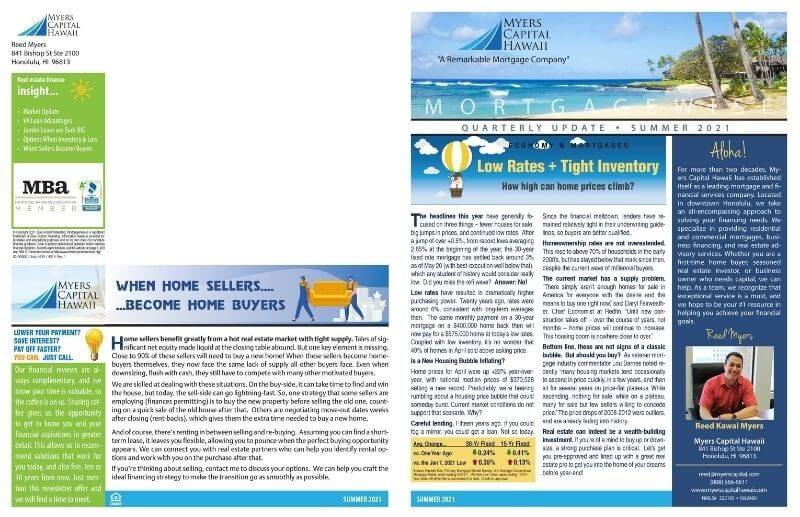
  • Quarterly Newsletter – Summer 2021

    Quarterly Newsletter – Summer 2021

    Get the latest mortgage industry news. Click here.

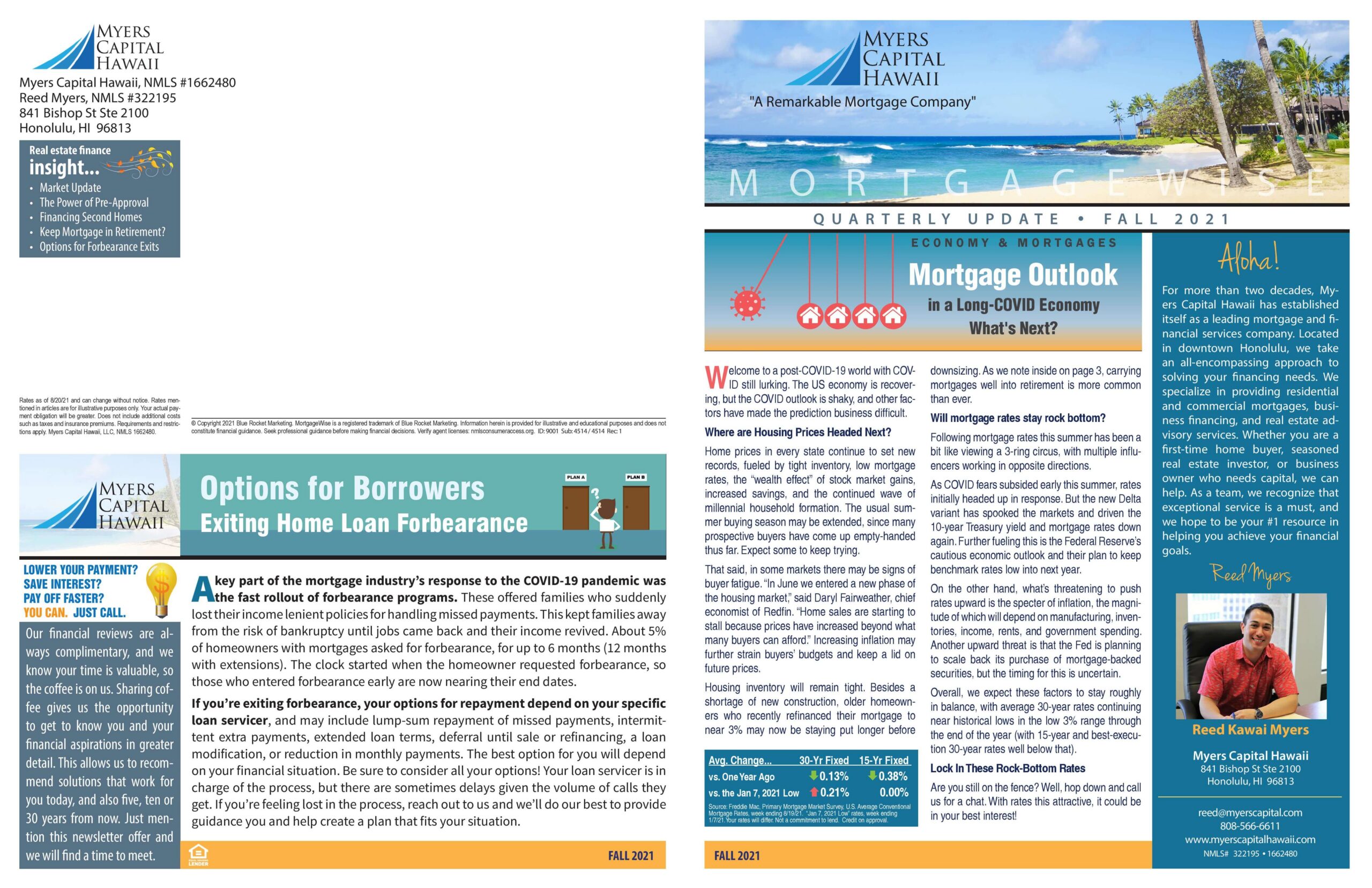
    – Low Rates + Tight Inventory – How high can home prices climb?
    – 5 Key VA Loan Advantages
    – Jumbo Loans are Back BIG – Down payments from just 10%
    – Outbid on a new home? Consider a renovation project loan.
    – When Sellers Become Buyers – How to handle low purchase inventory when selling  

    Copyright © 2021 Myers Capital Hawaii

  • 5 VA Loan Myths Busted

    5 VA Loan Myths Busted


    Low housing inventory means homeowners are flooded with multiple offers. With the VA Loan, though, veterans and active duty servicemembers have benefits that can give you an edge. One myth about VA loans is that the appraisal and closing process is tougher, but it’s not really true. The entire VA loan timetable is generally on par with conventional loans, and can be done in as little as 30 days, making it similar to conventional fast-close programs.

    The appraisal process takes about the same amount of time as a regular appraisal. The main difference is that fixer-uppers are not allowed – the home must be in safe, sound, and sanitary condition. It helps to choose a REALTOR® who has solid experience helping military clients, as they’ll know which homes for sale today to avoid. We work with several, so ask us for a referral!

    You may have heard that VA loans have higher credit standards. Again, not true. The bottom credit range for most VA lenders is actually much more lenient than that of conventional loans. If you’ve had a bankruptcy or foreclosure in your past, the VA loan is actually much more forgiving in that the waiting period is shorter before you can get a new loan – only 2 years post-foreclosure or Chapter 7 bankruptcy (vs 3 and 7 years for conventional loans) and as little as 12 months for a Chapter 13 bankruptcy. Talk to us if this is in your history.

    Perhaps the most well-known benefit of the VA loan is the 0% down payment requirement. This lets you preserve cash. Having cash gives you options, which gives you a leg up on other buyers bidding on a home you want. In fact, and to bust another myth, you can even use VA purchase loans on foreclosed and short-sale properties – – and with no money down, this gives you a huge edge over other buyers who have to come up with 20% down to satisfy conventional lenders. As long as the property is (you guessed it) safe, sound, and sanitary.

    VA loans also include the VA funding fee – a one-time payment that may range from 1.4% to 3.6% for a purchase or construction loan. A little-known fact is that this fee can be paid up front or rolled into the loan amount, and if you have available cash to use as a down payment, you can reduce it significantly by putting either 5% or 10% down. There are also exemptions to the VA funding fee (for veterans with a service-related disability, or those who have received the Purple Heart).

    Another myth is that servicemembers deployed overseas aren’t able to buy a home remotely or meet the occupancy requirement. Military members stationed overseas can use a Power of Attorney (POA) to appoint a spouse or someone else to handle the VA loan transaction, including signing! A spouse can meet the occupancy rule (moving in within 60 days), or you can get an extension of up to 12 months to occupy the home. There are a few details, so contact us for more info if this is your situation.

    Remember, loan limits were eliminated for most VA loan borrowers last year, letting you bid on just about any house you can qualify for!

    The VA loan advantage can be beneficial in today’s competitive market. If you’re a veteran or active servicemember, we can help you with the right strategy.

    Free VA Loan Consultation


    To find out more or start the process, call us at 808-566-6611.

    Copyright © 2021 Myers Capital Hawaii 

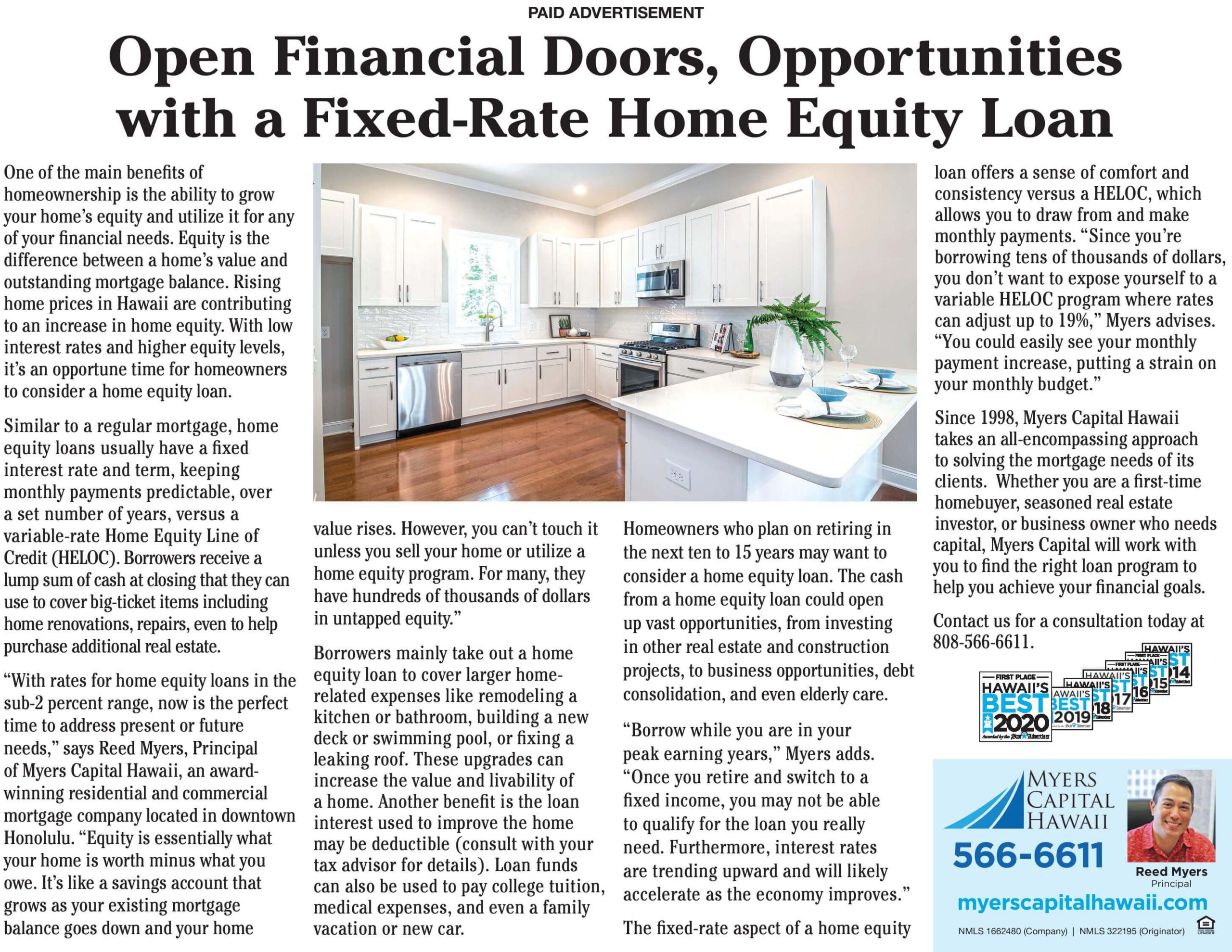
  • Open Financial Doors, Opportunities with a Fixed-Rate Home Equity Loan

    Open Financial Doors, Opportunities with a Fixed-Rate Home Equity Loan


    One of the main benefits of homeownership is the ability to grow your home’s equity and utilize it for any of your financial needs. Equity is the difference between a home’s value and outstanding mortgage balance. Rising home prices in Hawaii are contributing to an increase in home equity. With low interest rates and higher equity levels, it’s an opportune time for homeowners to consider a home equity loan.

    Similar to a regular mortgage, home equity loans usually have a fixed interest rate and term, keeping monthly payments predictable over a set number of years, versus a variable-rate Home Equity Line of Credit (HELOC). Borrowers receive a lump sum of cash at closing that they can use to cover big-ticket items including home renovations, repairs, or even to help purchase additional real estate.

    “With rates for home equity loans in the sub-2 percent range, now is the perfect time to address present or future needs,” says Reed Myers, Principal of Myers Capital Hawaii, an award-winning residential and commercial mortgage company located in downtown Honolulu. “Equity is essentially what your home is worth minus what you owe. It’s like a savings account that grows as your existing mortgage balance goes down and your home value rises. However, you can’t touch it unless you sell your home or utilize a home equity program. For many, they have hundreds of thousands of dollars in untapped equity.”

    Borrowers mainly take out a home equity loan to cover larger home-related expenses like remodeling a kitchen or bathroom, building a new deck or swimming pool, or fixing a leaking roof. These upgrades can increase the value and livability of a home. Another benefit is the loan interest used to improve the home may be deductible (consult with your tax advisor for details). Loan funds can also be used to pay college tuition, medical expenses, and even a family vacation or new car.

    Homeowners who plan on retiring in the next ten to 15 years may want to consider a home equity loan. The cash from a home equity loan could open up vast opportunities, from investing in other real estate and construction projects, to business opportunities, debt consolidation, and even elderly care.

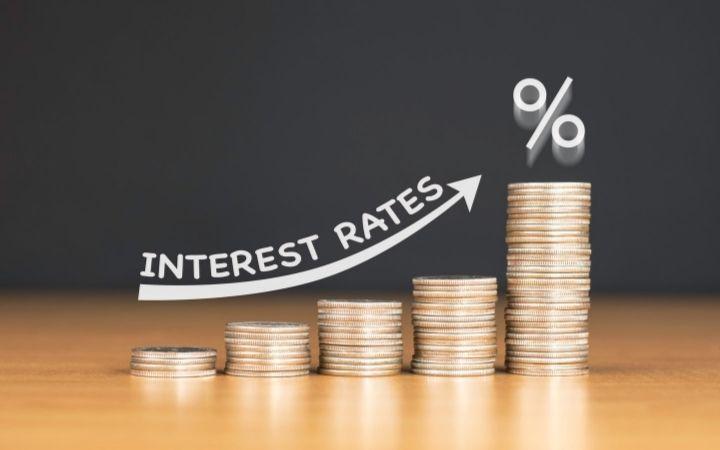
    “Borrow while you are in your peak earning years,” Myers adds. “Once you retire and switch to a fixed income, you may not be able to qualify for the loan you really need. Furthermore, interest rates are trending upward and will likely accelerate as the economy improves.”

    The fixed-rate aspect of a home equity loan offers a sense of comfort and consistency versus a HELOC, which allows you to draw from and make monthly payments. “Since you’re borrowing tens of thousands of dollars, you don’t want to expose yourself to a variable HELOC program where rates can adjust up to 19%,” Myers advises. “You could easily see your monthly payment increase, putting a strain on your monthly budget.”  

    Since 1998, Myers Capital Hawaii takes an all-encompassing approach to solving the mortgage needs of its clients.   Whether you are a first-time homebuyer, seasoned real estate investor, or business owner who needs capital, Myers Capital will work with you to find the right loan program to help you achieve your financial goals.

    Reach out to us for a no-cost loan consultation and rate quote.

    Article published in the Business section of the Star Advertiser, Tuesday, March 23, 2021. Click here to view article


  • Free Tax Return Analysis

    Free Tax Return Analysis

    Don’t Get Disqualified Due to Your Tax Returns!


    If you’re looking to make a home purchase, refinance, apply for a home equity or HELOC, then don’t miss this no-cost opportunity to get a loan you may need now and in the future.

    How income, expenses, and deductions are declared on tax returns can affect a borrower’s mortgage application. We can help provide a free tax return analysis to help better position you to qualify for a home loan.

    Is This You?

    Here are a few commonly overlooked scenarios that can make it harder to qualify for the loan you need:
    – Thinking of refinancing or purchasing later this year or next?  
    – Want to take out a fixed-rate home equity loan or HELOC?
    – Income changing due to new job or retirement?
    – Have or want to purchase an investment property?  
    – Self-employed/business owner?
    – A W-2 employee who switches to self-employed or business owner?
    – Business owner who changes company type to an LLC?
    – Landlord who deducts maintenance, repairs, property management expenses, etc.?

    Benefits for Qualified Borrowers
    – Get approved for a mortgage, refinance or HELOC you need
    – Obtain a competitive rate  
    – Lower monthly payments and interest costs
    – Tap into equity for home renovations, repairs, college tuition, debt consolidation, etc.

    Sign up for a free tax return analysis today. 

    Call 808-566-6611 or click below to register.

    Article published in the Business section of the Star Advertiser, Tuesday, March 23, 2021. Click here to view ad.


    Note: The information to be provided is for informational purposes only. Myers Capital Hawaii does not provide tax, legal or accounting advice. You should consult with your own tax, legal and accounting advisors before engaging in any transaction.


  • Quarterly Newsletter – Spring 2021

    Quarterly Newsletter – Spring 2021


    Get the latest mortgage industry news. Click here.
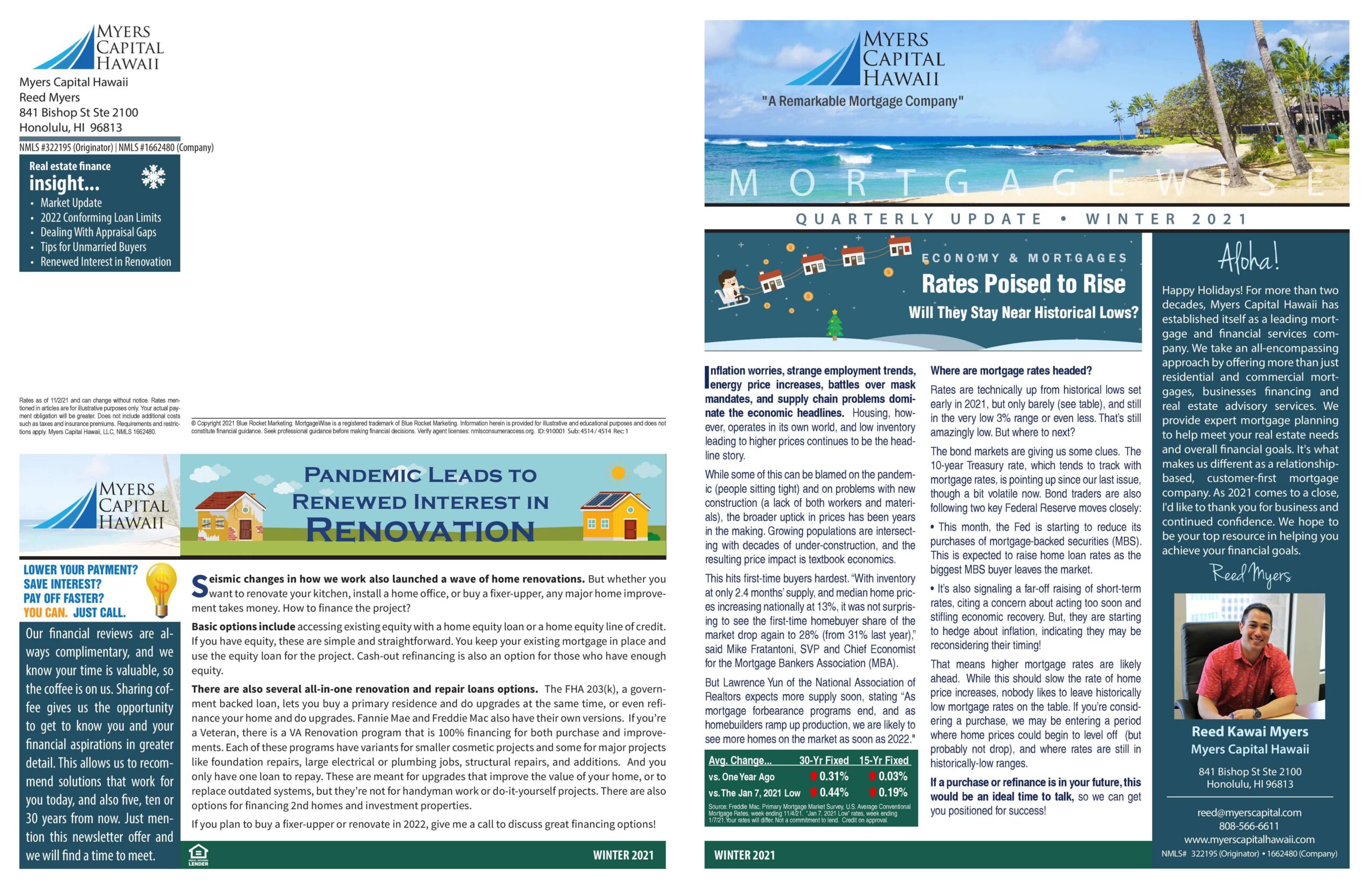
    – Where are rates headed in 2021?
    – Changes to come to Qualified Mortgages and how they affect borrowers.
    – Demand grows for cash-out refinances as home prices rise and rates stay low.  
    – Conforming loan limits increase for 2021.
    – Buying in a tight market? Your financing strategy can make the difference.

    Copyright © 2021 Myers Capital Hawaii

  • 5 Most Important Reasons Why Refinancing Makes Sense Today

    5 Most Important Reasons Why Refinancing Makes Sense Today

    For many homeowners, their largest debt obligation and monthly expense is their mortgage – especially in Hawaii. Because of this, it makes financial sense to dedicate attention to the type of mortgage you have, and your interest rate.

    Today, rates are at one of the lowest points we have seen in history. Anybody with a mortgage rate of 3% or higher on a 30-year fixed, or 2.75% or higher on a 15-year fixed can likely benefit from a rate drop. Even slight interest rate drops of 0.75%, 0.5% or even 0.25% on larger loan sizes ($200k plus) can make a considerable difference in lowering your monthly payment, paying off your loan years earlier, or unlocking equity for other purposes.

    Mortgage refinancing involves replacing your current loan with a new loan. Like the original mortgage, borrowers need to undergo an application process and meet certain qualifications, including income, credit, debt and asset verification. During these challenging times, it is even more important to seek the advice of a seasoned mortgage professional as you could be leaving thousands of dollars on the table.

    “Refinancing allows you to change the interest rate and terms of your original mortgage, and today’s low rates make it an opportune time to do so,” says Reed Myers, Principal of Myers Capital Hawaii, an award-winning residential and commercial mortgage company, located in downtown Honolulu. “When considering refinancing, it’s important to determine your financial goals, plans for the property, and even potential changes in your income, as many homeowners are experiencing right now. The decisions you make today could set the stage for a much more abundant financial future.”

    Here are 5 key reasons a homeowner should refinance:

    Reduce monthly payment. This is the most common reason to refinance. An interest rate drop means the interest portion of your monthly payment will be reduced and depending on the term selected, this would likely decrease your monthly payment, sometimes significantly.

    Tap into home equity or consolidate debt. Have a renovation like a home-office space or a new construction project in mind? Want to consolidate debt like credit cards? You can select a cash-out refinance, which replaces your existing mortgage with a larger loan. The difference can be used to fund home renovations, pay down debt, or cover a financial emergency. Other financing options include a Home Equity Loan or Home Equity Line of Credit.

    Eliminate private mortgage insurance (PMI). Homeowners who put down less than 20 percent of the purchase price will typically pay PMI, which can add hundreds of dollars to monthly payments. Refinancing may remove PMI if the new mortgage balance is 80 percent or less of your home’s value. Mortgage insurance can vary, but in Hawaii, typically it will be $100 to $500 per month or even more. Eliminating PMI can have a large impact on lowering your monthly expenses.

    Convert to a fixed-rate loan. Rates on an adjustable-rate mortgage or Home Equity Line of Credit are reset after a set timeframe and can move higher. Many times after the expiration of the “teaser rate” (typically one to three years), the HELOC will have a “floor rate.” A floor rate is the lowest rate that the HELOC will have throughout the remaining life of the loan. Many HELOCs have floor rates of 4.5%, considerably higher than the current market. A lower, fixed-rate loan can provide peace of mind knowing your interest rate and payments will not increase in the future.

    Pay off loan faster. If your original loan term is 30 years, you can refinance into a 20 or 15 year fixed, shaving years off your loan.

    Myers Capital Hawaii can help. Since 1998, the company takes an all-encompassing approach to solving the mortgage needs of its clients. Whether you are a first-time homebuyer, seasoned real estate investor, or business owner who needs capital, Myers Capital will work with you to find the right loan program to help you achieve your financial goals.

    Contact us for a consultation today at 808-566-6611.

    Article published in the Business section of the Star Advertiser, Tuesday, February 23, 2021. Click here to view article

  • Veterans: Now’s the Time to Refinance Your VA Loan

    Veterans: Now’s the Time to Refinance Your VA Loan

    Hawaii’s high mortgage debt

    Pacific Business News reports that Hawaii has the third-highest average mortgage debt in the country, at $344,819, according to a 2019 Experian report. Only the District of Columbia ($418,555) and California ($363,537) had more mortgage debt per borrower as of 2019. In comparison, the national average mortgage debt nationwide was $202,284, held at an average interest rate of 4.37%.

    Looking at the top 100 major metropolitan statistical areas, Honolulu residents also rank very high, with an average mortgage debt per borrower of $365,288. That represents an increase of 3.3% compared to the prior year, according to Experian’s data. 

    Naturally, that translates to high mortgage payments: According to U.S. Census data, Hawaii’s average monthly payment, $1,747, is second only to Washington D.C.’s $1784, and outstrips California’s average payment of $1,642.00.

    Take advantage of low interest rates

    Because of our high mortgage balances here in Hawaii, we also have much more to gain than almost any other market by taking advantage of today’s extremely low interest rates and refinancing.  

    The reason: We’re simply working with bigger numbers in Hawaii. Small interest rate advantages in Hawaii are leveraged into more significant gains, when it comes to freeing up cash flow each month. 

    And if you’re a veteran who bought your home with a VA loan, it’s practically a no-brainer. The VA’s Interest Rate Reduction Loan program – called the “Streamlined Refinance Program” in many circles, because it’s so easy, fast and straightforward – makes refinancing a snap for qualified VA borrowers.

    Lower your mortgage payment

    The VA Interest Rate Reduction Loan (IRRL) is designed to do just what it says: Make it easy for veterans to lower their monthly mortgage payments and instantly free up cash flow every month by lowering the interest rate on the loan.

    Potential savings for Hawaii homeowners

    Every situation is different. But it’s possible to estimate potential savings for the average Hawaii homebuyer who wants to lower their monthly payments and chooses a 30-year term.
    As of this writing (early May 2020), the average interest rate on newly-issued 30-year mortgages is 3.51%, according to Bankrate.com.

    Those with strong credit, or who are borrowing over shorter terms can usually qualify for even lower rates, but 3.51% is the average this week.

    Hawaii-specific refinance example

    In our example, we’re making the following assumptions:

    • The borrower has the average mortgage balance in Hawaii of $344,819;
    • The borrower is paying the average current interest rate of 4.37%.
    • The borrower will refinance the loan to today’s average rate of 3.51%.  
    • The borrower pays nothing out of pocket (there is a VA loan fee of 0.5%, wrapped into the loan).
    • No PMI


    Original VA Mortgage

    New IRRL Refinance Loan


    Average balance (Hawaii)


    $344,819

    Interest Rate

    4.37% (Source: Experian)

    3.51% 

    (Source: Bankrate.com)

    Monthly payment, 30-year mortgage

    Current average: $1,747 

    (Source: U.S. census data)

    $1,550

    Monthly Savings ($1747-$1550


    $197


    In this scenario, the monthly cash savings is $197 per month. The ‘break-even point’ (the point at which the monthly savings exceeds the cost of refinancing) is in less than a year.

    There are a few more variables to consider – including how old your current loan is and how much time is remaining in the term.

    You can take that extra cash you get every month and put it to better use:

    • Pay down high-interest credit card balances;
    • Pay off car loans;
    • Invest for retirement;
    • Save for college;
    • Put it towards the purchase of an investment property

    “Don’t make the decision in a vacuum,” Myers advises Hawaii homeowners. “It’s a good idea to think about the most productive things you can do with any monthly savings. Always keep your eye on the big picture, and your overall financial goals.

    Maximize savings over the life of the loan

    To maximize your savings over the life of the loan, you can refinance to a shorter term – usually at an even lower interest rate, though the monthly payment will be higher. The average 15-year loan interest rate is 2.95% (for a monthly payment of $2,373. That’s much higher than a 30-year payment. But compared to a 30-year loan at 3.53%, that higher payment builds up equity much faster, and it saves more than $170,000 over the life of the loan.

    Convert from variable to fixed-rate

    Or if you currently have a variable rate loan, the IRRL makes it equally easy to ‘lock in’ historically low interest rates, and eliminate the risk of your mortgage rate and payment going up for the life of the loan.
     
    “This is particularly important in Hawaii, because of the high balances we have here,” says Reed Kawai Myers, principal at Myers Capital Hawaii, a local family-owned mortgage broker in Honolulu. “With variable mortgages, even a small increase in interest rates can have a significant effect on family budgets, when payments get reset. Now’s a great time to refinance and get today’s rate locked in.”

    Underwriting

    The VA Streamline Refinance program is different from most refinance loans. Typically, borrowers in non-VA loans have to go through underwriting all over again in order to refinance. That means a credit check, a lengthy income verification process, a new home appraisal, and a process that can take weeks.

    But VA borrowers have an advantage: With the VA IRRL program, there’s next to no underwriting requirements: 

    • No credit check required
    • No employment verification
    • No appraisal required
    • No new VA certificate of eligibility required.

     Are you eligible?

    The eligibility requirements for the VA IRRL program are straightforward:

    • You must have a VA-backed mortgage, and;
    • You must use the IRRL to refinance the existing VA mortgage, and;
    • You must certify that have lived in the home at some point, and;
    • You must have made at least six payments on the existing VA mortgage, or 210 days must have elapsed since you got it (whichever is longer).  

     Can I get cash out?

    The VA Streamline Refinance loan isn’t designed for cash-out’ refinances. IRRRL cash out is restricted to $6,000 for qualifying energy improvements you will complete within 90 days. If you want to turn some of your home equity into cash, let us know. The VA has an excellent cash-out mortgage refinance program for veterans, too. And we can look at some other options, as well.

    Refinancing a rental property

    You can use a VA Streamlined Refinance loan to refinance either a personal residence or a rental property. All you have to do is verify that you did, in fact, live in the home at some point since you took out the original VA mortgage.

    It is true that an original VA mortgage can only be used to purchase an owner-occupied home. But you only have to stay in the home for a year. If you’ve since moved out and turned it into an investment property, you can still use a VA IRRL mortgage.

    Limits.

     You cannot borrow more than your original VA loan amount.

    Get Started.

    Our experienced mortgage advisors can determine if refinancing can help meet your financial goals. To find out more or start the process, call us at 808-566-6611. 

  • Quarterly Newsletter – Spring 2019

    Quarterly Newsletter – Spring 2019

    Get the latest mortgage industry news. Click here.
    – Declining mortgage rates
    – Financing a duplex as your first real estate investment
    – Millennials are active homebuyers
    – Prequalified versus preapproved. Confused about the difference?
    – House flipping is back

    Copyright © 2019 Myers Capital Hawaii

  • 8 Things You Should Know About Homebuying

    8 Things You Should Know About Homebuying

    It’s possible to obtain a mortgage with a credit score in the mid-500s. However, a good goal to have is 700 plus. Typically installment debt (personal loans, car loans) looks better than revolving debt (credit cards), but if you do have revolving debt, try to pay attention to the balance in relation to the limit.

    Finding the right balance between saving money and paying debt will be different for everyone’s situation. Things to consider are:

    • Minimum down payment required for the price point you are looking at.

    • The amount of total debt that you currently have

    • The minimum monthly payments required on these debts.

    As a rule of thumb, if you are looking to buy a home, you shouldn’t switch from being a w2 employee to being self-employed. However, vice versa is okay. If you are self-employed, generally your income after all expenses within the past 2 years will be taken into account. Typically you must be self-employed for at least 2 years however it is possible to obtain a mortgage with only 1 year of self-employment income.

    It’s never too early to start! One of the biggest mistakes homebuyers make is waiting until they are about to make an offer before they decide to get pre-approved. Having a mortgage advisor review your credit and financials as early as possible is highly advised. Dedicating a small amount of time early on, will make things incredibly smoother during your homebuying process.

    Tis the season for giving! Did you know relatives are allowed to gift you money for your down payment? That money does not necessarily need to come from their bank account. If they own a home, parents/relatives may be able to tap into their equity through a Home Equity Loan and gift that money to you for a down payment. Other options are co-signing and gifting of equity. 

    Rising interest rates can have a direct impact on how much you qualify for. As a rule of thumb, every 1% rise in interest rates can reduce your buying power by 10%. Interest rates are expected to rise 1% within the next 12 months. For example if you qualify for a $600,000 home today, you may only be able to qualify for a $540,000 home 1 year from now. 

    Planning to live in your property for at least one year? For Veterans, the VA home loan allows you to purchase a home up to $726,525 with no money down and no monthly mortgage insurance. For Non-Veterans with good to excellent credit, you can purchase a property up to a max purchase price of $748,994 for only $22,470 down with no monthly mortgage insurance.

    Looking to buy a home? This may be your opportunity! The housing inventory for single-family and condos in Honolulu has increased by over 30% and over 13% respectively. At the same time the # of both closed sales and pending sales has dropped double digits in Oct 2018, compared to Oct 2017. What does this mean for you? There are more homes on the market to choose from and less active buyers for you to compete with. Interest rates although on the rise, are still historically extremely low. This may be the opportunity you’ve been waiting for!