Blog

  • 2023 Conforming Loan Limits Reach Record Levels

    2023 Conforming Loan Limits Reach Record Levels

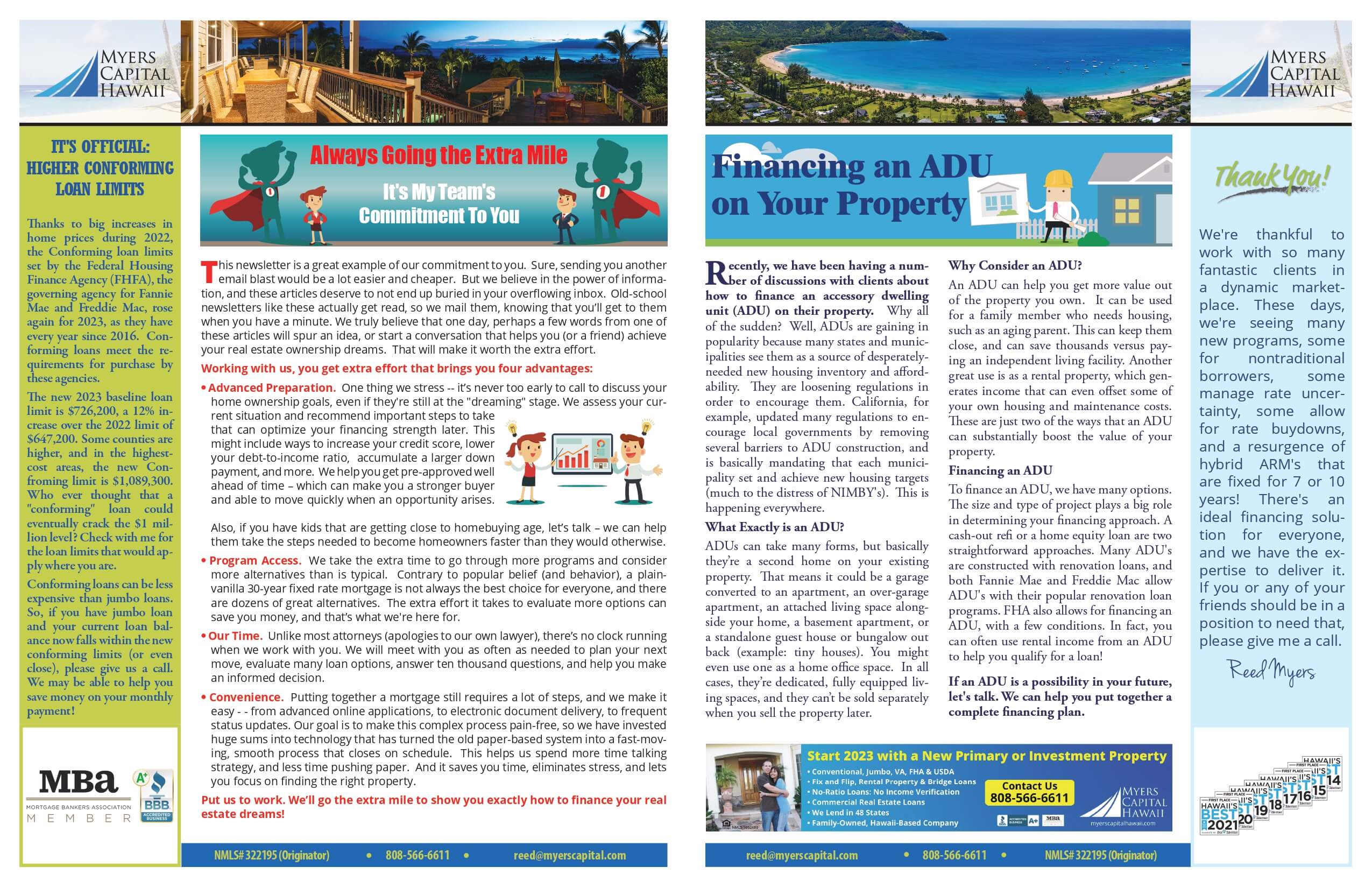
    New 2023 loan limits for conforming mortgages will be $726,200 and exceed $1 million in higher-cost areas like Hawaii. The Federal Housing Finance Agency (FHFA) recently announced these conforming loan limit amounts for mortgages to be acquired by Fannie Mae and Freddie Mac.

    The 2023 baseline conforming loan limit of $726,200 is up $79,000 from this year’s limit of $647,200. In higher-cost areas, the loan limit is $1,089,300, or up to 150% of the baseline national loan limit. This year’s loan limit in high-cost areas is $970,800.

    Units
    Baseline Limits
    High-Cost Area Limits
    One
    $726,200
    $1,089,300
    Two
    $929,850
    $1,394,775
    Three
    $1,123,900
    $1,685,850
    Four 
    $1,396,800
    $2,095,200 

    Loan limits are tied to average U.S. home prices, and 2021 and 2022 featured price increases at record levels. In the third quarters of 2021 and 2022, home prices jumped 12.21%, requiring 2023 baseline loan limits to increase by the same percentage, according to the FHFA. In Hawaii, the highest median sales price in 2022 for a single-family home was recorded at $1,153,500 in May.

    2023 conforming loan limits are available by clicking here.

    Benefits of Higher Loan Limits 
    Homebuyers 
    -Lower Monthly Payment and Overall Loan Costs: Purchasing a home with a conforming loan versus a higher-cost jumbo loan can lower your borrowing costs. Conforming loans generally have better interest rates, lower costs, and flexible down payment, credit and qualification guidelines.
    -Increased Purchasing Power: Apply for a larger loan to buy a better home with a remodeled kitchen, extra bedroom, more space, or in a preferred location.

    Homeowners 
    -Tap into more equity with a cash-out refinance to pay down debt, cover college tuition, or make home improvements.
    Refinance: If you have a jumbo loan with a balance near a new loan limit in your area, you may benefit by refinancing to a conforming loan.

    Ready to Discuss Your Mortgage Options? 
    If you’re considering a new home purchase or refinance, reach out to our seasoned mortgage advisors to discuss your loan options. Call 808-566-6611 or request a no-obligation consultation online

  • Mortgage Newsletter Winter 2022

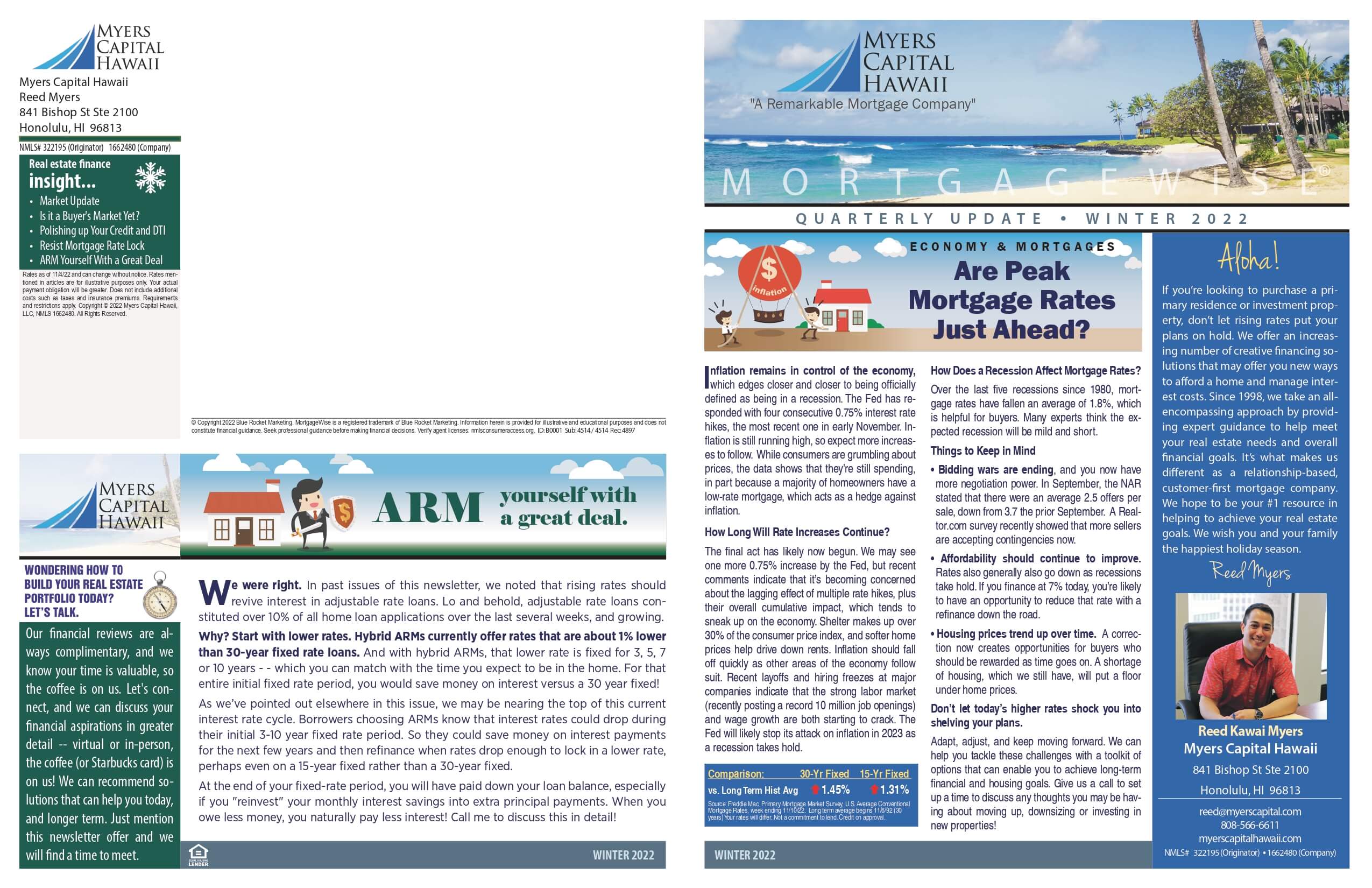
    Mortgage Newsletter Winter 2022

    Get the latest mortgage industry news. Click here.

    – Economy & Mortgages: Are Peak Mortgage Rates Just Ahead?

    – Polish Up Your Credit Scores and DTI’s to Get the Best Rates

    – Resist Mortgage Rate Lockdown Mentality

    – Is it a Buyer’s Market Yet?

    – ARM yourself with a great deal


    Copyright © 2022 Myers Capital Hawaii

  • Mortgage Newsletter Fall 2022

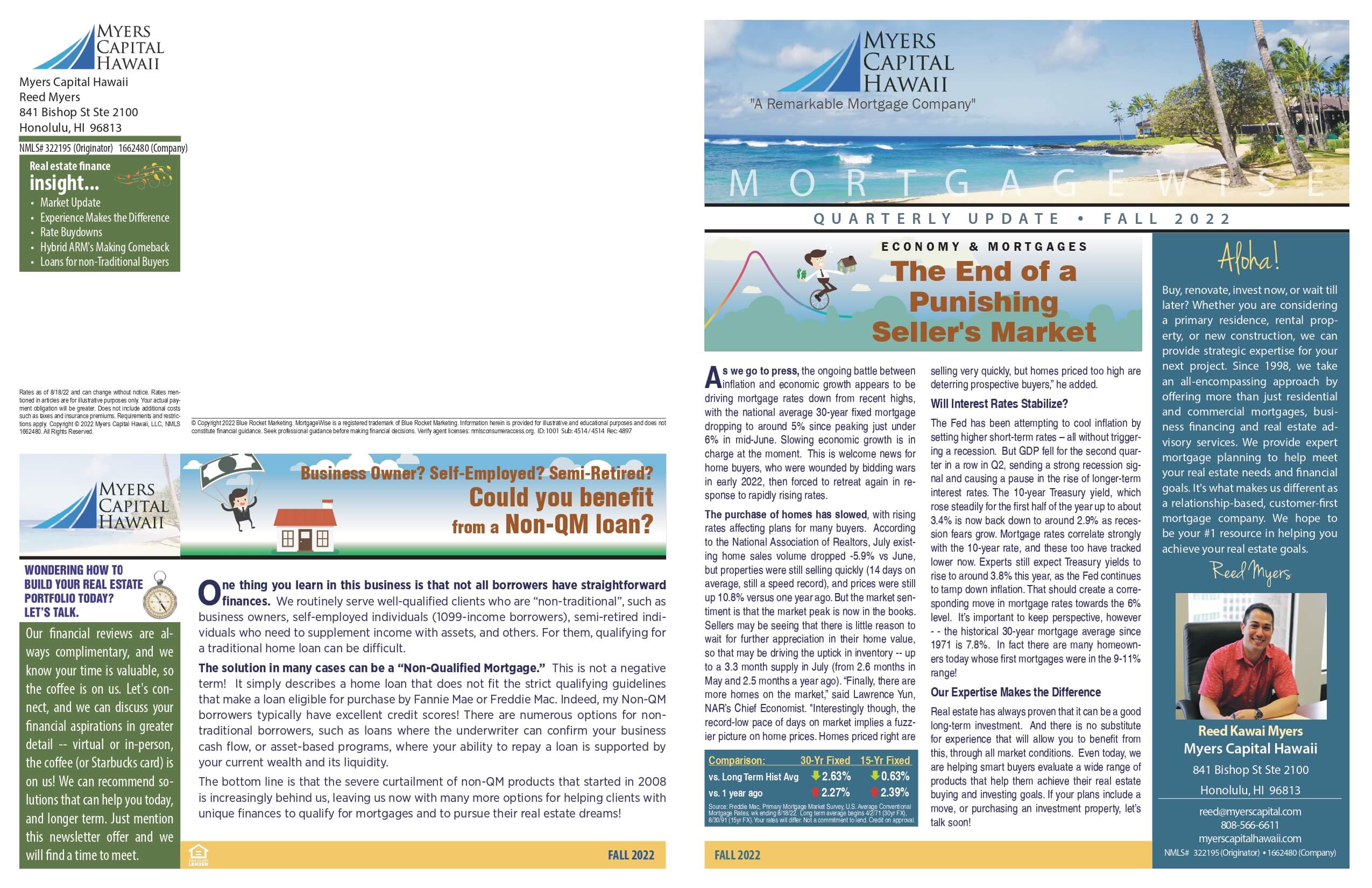
    Mortgage Newsletter Fall 2022

    Get the latest mortgage industry news. Click here.

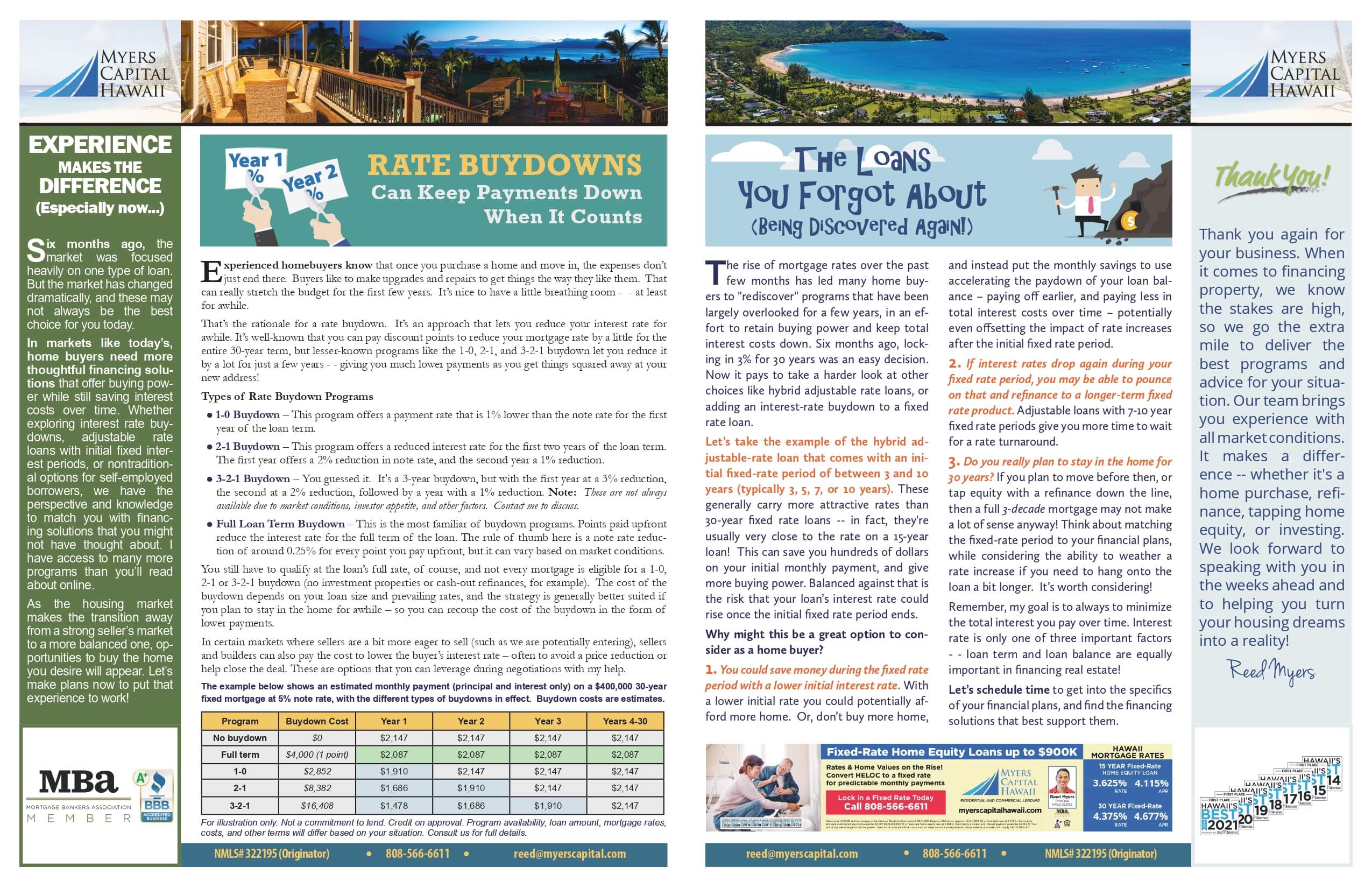
    – Economy & Mortgages: The End of a Punishing Seller’s Market

    – Rate Buydowns Can Keep Payments Down When It Counts  

    – The Loans You Forgot About (Being Discovered Again!)

    – Business Owner? Self-Employed? Semi-Retired? Could you benefit from a Non-QM loan?

    Copyright © 2022 Myers Capital Hawaii

  • 5 Ways to Use Your Home Equity to Help Family Members Buy a Home

    5 Ways to Use Your Home Equity to Help Family Members Buy a Home

    With many Americans sitting on an increasing amount of home equity, some are now leveraging that asset to help younger generations of their family get into homes.

    Many families are watching their kids try to take on today’s daunting real estate market. Even with good income, it’s hard for a younger buyer to compete with all-cash offers and fix-and-flip investors.

    Rising rents, student debt, and inflation have all slowed down the process of building a large down payment. Indeed, the National Association of Realtors notes that close to 90% of home buyers under the age of 40 finance more than the traditional 80% of their home purchase.

    How, then, to apply your financial resources to help your kids get into their first home?

    Here are 5 great approaches:

    – A down payment gift from your equity. By tapping into equity, you can generate cash to make a large down payment gift. According to the National Association of Realtors, 23% of first-time buyers used gifted funds. Gifts are tax-free up to $16,000 per person per year (for 2022). Above that, you have to file a gift tax return. Talk to us first about how to do gifting correctly!

    – Co-signing their mortgage, and providing some of all of the down payment from your equity or savings. The upside is that it can put them in a much stronger position to buy, offset credit issues they may have, and help them get a bigger loan. Expect to be liable for payments if they fail to make them (impacting your own credit score), and plan to refinance to get off the mortgage, later on.

    Your home equity could also help you buy a multi-unit property together, where they could live and rent out one unit to help offset their mortgage payments.

    Use your home equity to help renovate a fixer-upper that they actually can afford. Remember, there’s often less competition for these “unloved” homes!

    – If your situation permits it, you can buy a house for your child to live in and work out a process whereby you gift them a portion each year (to stay below gift tax limits) and also have them buy it back from you when they have saved enough.

    Bottom line, built-up equity gives you options.

    We can show you flexible programs that can help you tap into your home’s equity. All this takes careful planning, so give me a call to help you build a great strategy for helping your kids on the road to home ownership!

    Copyright © 2022 Myers Capital Hawaii  

  • Home Equity is Way Up: Are You Taking Advantage Of It?

    Home Equity is Way Up: Are You Taking Advantage Of It?

    With the rapid rate of home value increases across the country, many homeowners have found themselves sitting on a substantial amount of home equity. So called “tappable equity,” the amount a homeowner can access while still retaining at least 20% equity, rose by a whopping 32% between late 2020 and 2021, with further increases this year, according to Black Knight, a real estate analytics company.

    If you have decided to stay put, rather than try to purchase an upgraded home, there may be a reason to use some of that equity to improve how your home supports your desired lifestyle.

    Upgrade in place? With limited inventory and bidding wars, sometimes the grass isn’t greener on the other side of the fence. Expanding, or upgrading the features of your current home may be just the ticket.

    Work at home? All office workers cherish the chance to work from home part of the time, but a clear separation between family activities and work time makes working from home less stressful and more productive. Adding dedicated office space or reconfiguring rooms to create separation between workspaces and family spaces could be a smart move.

    Aging in place? You can make modifications to improve mobility and accessibility, so you are able to stay in your home into your later years. In effect, investing now in upgrades extends the time the home can support your retirement lifestyle! This can also the time when expensive long-term care must begin.

    Space for parents? Many properties are zoned to allow an “accessory dwelling unit” (ADU) to be built. Also known as “mother-in-law units,” these separate studio or one-bedroom units allow you to house aging parents, other family members, and even renters. These can add significant long-term value. Many municipalities are rezoning properties to allow for these, in order to address the housing inventory crunch.

    So, how best to tap your home equity to upgrade your home? Fortunately, you have a number of options. We can help you work the numbers to decide which is best for your situation.

    • The cash-out refinance often makes the most sense, especially for larger projects, even at rates over 5%. Advantages? A fixed rate, and you just have one mortgage.

    • A home equity loan, which borrows a fixed amount at a fixed interest rate is often good for medium-sized projects. It’s a second lien, which sits on top of your existing mortgage.

    • A home equity line of credit, also a second lien, lets you spend money on your project on-demand, up to its maximum line limit. It remains open for future expenses once you pay the balance down. But it comes with a variable interest rate. For that reason, we don’t usually recommend these for larger projects that will take time to pay off.

    So “we need to do the math” to see which of these options would work best over time. With all the tools we have available, we can craft an excellent solution that will allow you to tap into that equity while minimizing the total interest you pay over time.

    Copyright © 2022 Myers Capital Hawaii 

  • Do Higher Rates Mean the End of Exploding Home Prices

    Do Higher Rates Mean the End of Exploding Home Prices

    Economy and Mortgages Update

    The average rate for a conforming 30-year fixed is now in the low 5% range, a full 2% higher than just a year ago, yet still (we repeat) historically attractive. The unusually-rapid increase is already starting to shift the market away from the seller’s market that has been driving up home prices, with Realtor.com reporting an increase in the share of homes seeing price reductions from 5.6% last April to 6.9% this April.

    That said, the lower end of the market is still hyper-competitive in many markets where most sellers retain considerable pricing power. So, while you may soon see reports of median home prices starting to drop here and there, it doesn’t necessarily mean that the average starter home is getting less expensive!

    Where are rates headed?
    In terms of mortgage rates, 40-year high inflation and the Fed’s unwinding of mortgage-backed securities (MBS) purchased during the pandemic are driving everything. We’re seeing the effects of trillions of dollars of stimulus pumped into the economy in 2020 and 2021. As of Q3, 2021, the Fed believed that pandemic-related supply bottlenecks would ease, taming the then-4% inflation, so rate increases were postponed to protect the economic recovery. This has proved to be a miscalculation.

    In Q4, inflation surged higher and hasn’t let up — 7.9% in February, 8.5% in March and 8.3% in April. While the Fed plans to act aggressively in raising rates to choke off inflation, the tepid March and April Fed actions (+0.75% combined) were basically ignored by longer-term securities like the 10-year Treasury and mortgage rates, which were already surging upward at a much higher pace. Since the record lows of last year, their 4-month increase to today’s levels is the most rapid in mortgage history. This has naturally spooked many prospective buyers.

    But an unexpected decline in first-quarter GDP of -1.4% announced in April has marked a sudden reversal for the recovering economy, and mortgage rate increases are currently slower. Experts now worry that if consumer spending eventually cracks under the weight of inflation, and if wage growth fails to keep up, the back half of 2022 could look grim. The Fed hopes to avoid being caught between roaring inflation and a stagnating economy (remember “stagflation” during the 70’s?). This economic backdrop will play a big role in what happens later this year, but near term, we expect further Fed increases and gradually higher mortgage rates that head toward the 6% range.

    For our customers, the message is simple: If you’re on the fence, get off. If you wish to buy or refinance (including tapping into equity), the time to make a move is probably now. Our experience can help you make great financial moves even in today’s changing marketplace. Give us a call today and let’s get the conversation rolling!

    Copyright © 2022 Myers Capital Hawaii
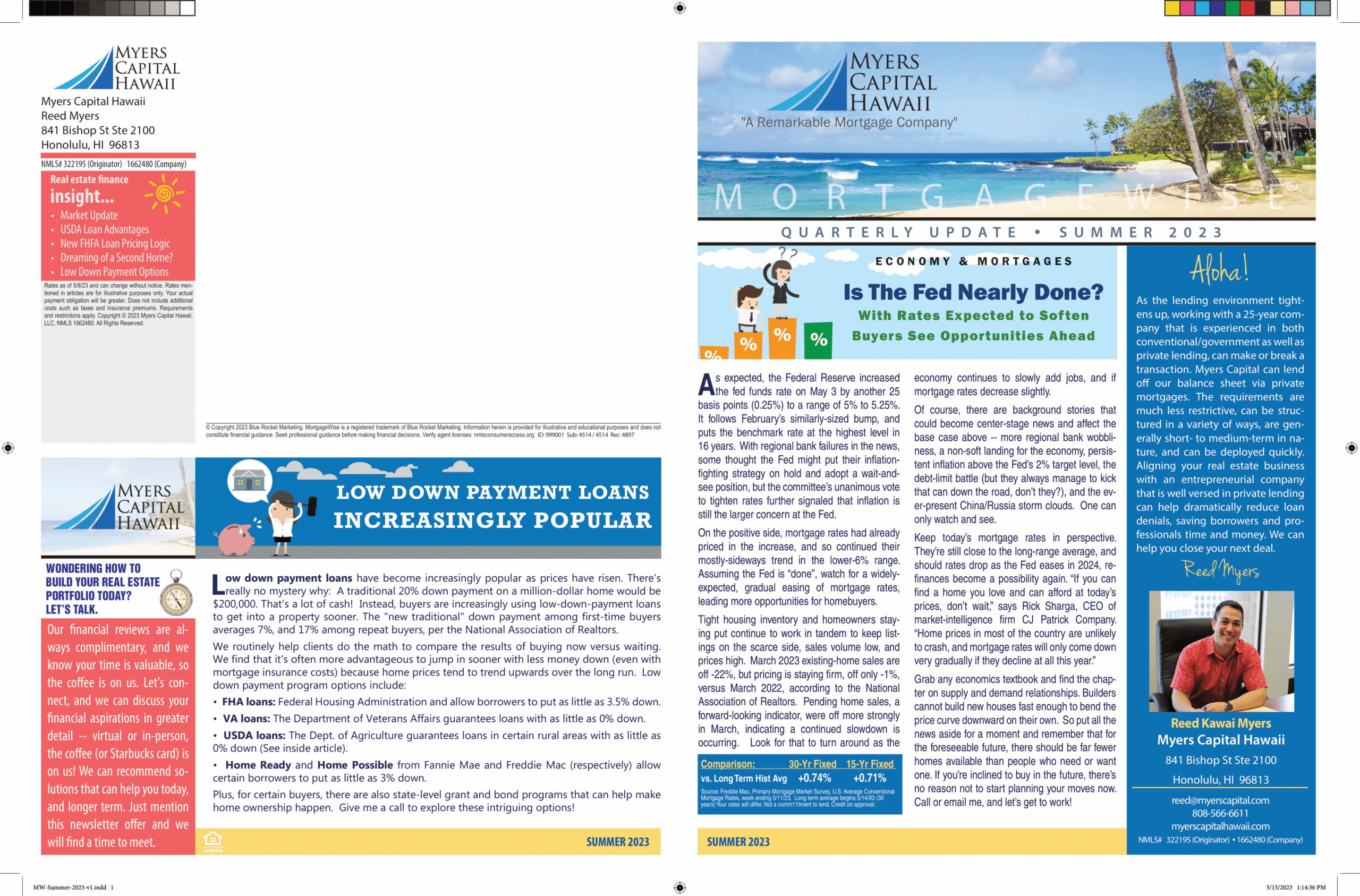
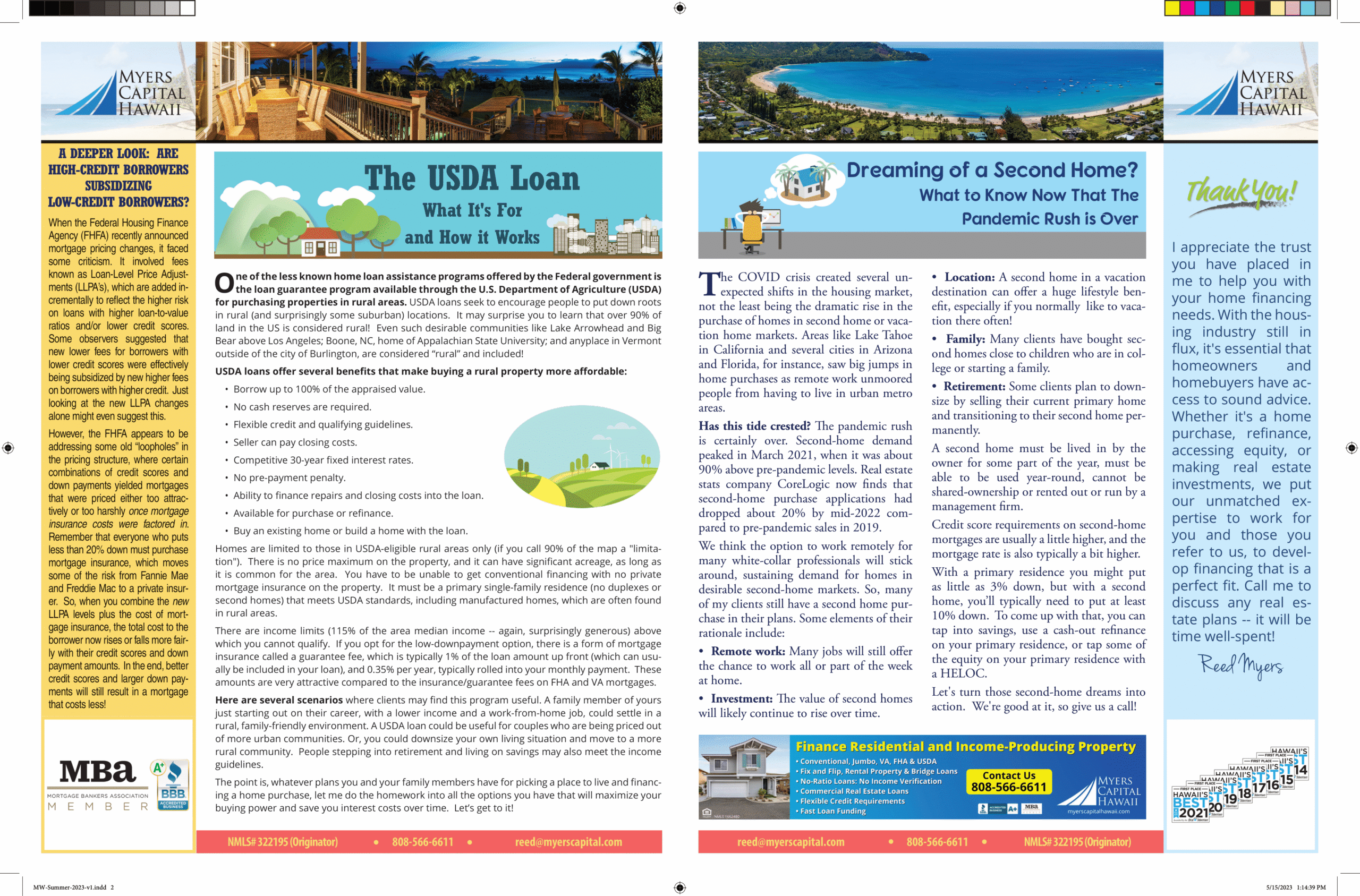
  • Mortgage Newsletter Summer 2022

    Mortgage Newsletter Summer 2022

    Get the latest mortgage industry news. Click here.

    – Economy and Mortgages: Do Higher Rates Mean the End of Exploding Home Prices?

    – Home Equity is Way Up: Are You Taking Advantage of it?

    – Using Your Home Equity to Help Family Members Buy a Home  

    – 40-year Mortgage Loans: Pros and Cons

    – Private Mortgage Insurance: When to Remove it from a Loan?


    Copyright © 2022 Myers Capital Hawaii 

  • New TV Commercials Focus on How We Help Clients Meet their Mortgage Goals

    New TV Commercials Focus on How We Help Clients Meet their Mortgage Goals


    Myers Capital Hawaii is proud to release two new TV commercials that showcase how the residential and commercial mortgage company helps their clients achieve their real estate financing needs. The 30-second spots feature the theme, “Let’s see what we can do for you,” and include testimonials from actual clients with appearances by employees, including company principal Reed Myers.  

    The first TV spot features clients Meredith Ross, and Ronald and Sylvia Young. Ross, a paralegal, had a construction loan to build a home and now needed a regular mortgage, which usually has better rates and terms than construction financing. Myers Capital Hawaii helped Ross replace her construction loan with a 30-year, fixed-rate mortgage. She later refinanced the mortgage to a lower rate, enjoying reduced monthly payments. She then wanted to tap into her home’s equity and requested a cash-out refinance, using the funds to start a business with her son.

    Ronald Young is a local Realtor who has used Myers Capital Hawaii to finance his clients’ home purchases and his personal mortgage with his wife, Sylvia. Like buying a home, a mortgage transaction can be an involved process and relies on seasoned professionals to assist clients for a smooth lending experience. “We enjoyed working with Reed at Myers Capital Hawaii. He made us feel comfortable throughout the loan process,” explains Ronald.

    The second TV spot showcases client Emmanuel S. Tipon, a local immigration attorney. Tipon requested to refinance the loan on his condominium in Waikiki. Myers Capital Hawaii was able to refinance his current loan to a new one with a better rate with more favorable terms, lowering his monthly payment and saving on overall interest costs. The company took the time to assess his situation, and explain loan options that would best fit his needs. “Myers Capital Hawaii gave me a brief education on mortgages, and through the education obtained, I was able to achieve my real estate goals, which was to keep my condominium in Waikiki,” says Tipon.

    Myers Capital Hawaii offers residential and commercial mortgages, business financing, and real estate advisory services. Since 1998, we take an all-encompassing approach by providing expert mortgage planning to help clients meet not just their real estate financing needs but also their overall financial goals. It’s what differentiates us as a relationship-based, customer-first mortgage company.

  • Want to Increase Cash Flow and Save on Taxes?

    Want to Increase Cash Flow and Save on Taxes?

    By Reed Myers, Principal
    Myers Capital Hawaii

    As we are now full swing in tax season, remember April 18th is this year’s tax deadline for most individuals.

    There are a few ways to use your mortgage to reduce your tax obligation, make renovations, or buy more real estate.

    One strategy is the Re-Amortizing, Cash-Out Method:

    – If you have a rental property, consider re-amortizing to a 30-year fixed rate to improve cash flow and tap into equity for renovations, purchasing of additional real estate, etc.

    – Although rates have been rising these past couple of months, we are still at historic lows compared to years past (see chart below).

    – If you took out a $300,000, 30 year fixed mortgage on your rental at 4.0% 7 years ago, your monthly payment is approximately $1,432, and you now owe $258,178.

    – With the dramatic increase in home values, you could take out a new $350,000, 30 year fixed loan at 4.0% and your monthly payment would increase by $238/month to $1,670/month ($1,670 – $1,432).  You now have a little less than $100,000 cash in hand.

    – Your collected rents have likely increased more than $238/month versus 7 years ago. The extra annual interest you’d be spending on this new loan would actually assist with your increased income tax liability as it offsets your rental income.

    – Your tenants will cover the debt service on the income producing property while allowing you to harvest larger tax deductions and obtain cash out of your property to invest in various ways. Win Win.

    Find how you can benefit from re-amortizing and taking out cash from your existing property. Contact me and we can discuss your situation and develop a custom plan that can fit within your real estate goals.

    This material has been prepared for informational purposes only, and is not intended to provide, and should not be relied on for, tax, legal or accounting advice. You should consult your own tax, legal and accounting advisors before engaging in any transaction. All mortgage products, rates, terms and conditions are subject to credit and property approval. This is not a commitment to lend or extend credit. Additional requirements and restrictions apply. Rates, terms and loan programs subject to change without notice.

  • Myers Capital Hawaii Expands to the Mainland

    Myers Capital Hawaii Expands to the Mainland


    By Stephanie Salmons – Reporter, Pacific Business News
    Published March 4, 2022

    Myers Capital Hawaii, a locally-owned company offering residential and commercial mortgages, has expanded to the Mainland, opening a new branch in Virginia.

    Named Myers Capital Virginia, the branch is headed by manager Tara Weston, a senior mortgage advisor with more than eight years of residential and commercial lending experience. Weston, who began her mortgage career with Myers Capital Hawaii, is a graduate of Virginia Tech, and specializes in residential and commercial mortgage lending.

    According to the company, the new branch offers a range of mortgage programs for residential and commercial real estate, including traditional home purchases, fix and flip bridge loans, and home equity loans.

    “We have been looking to expand our mortgage services from Hawaii to the U.S. Mainland and Virginia was a top choice for us due to its robust housing and jobs market,” Reed Myers, Principal of Myers Capital Hawaii and Myers Capital Virginia said in a statement. “We are focused on helping borrowers with their real estate financing needs with a wide range of products at highly competitive rates backed by our excellent service standards.”

    Myers told Pacific Business News it was the ongoing Covid-19 pandemic that allowed the company to “rethink things from a lot of different angles.” Myers, who took over the family company, which was based in South Carolina before moving back to Hawaii, said he hadn’t really thought about returning to the Mainland.

    But the company “had wind at our back” because of historically low interest rates and a shift in how it operated because of the pandemic.

    “Our company … over the past two years revamped how we communicate and how we do business,” Myers said. It made him rethink the ability to do business in places beyond Hawaii. “But being able to do it from Hawaii, that was kind of the approach that we took …”

    And because of the pandemic, people are more accepting of remote work. Virginia is Myers Capital Hawaii’s first Mainland expansion, but further growth is in the works.

    According to Myers, the company has a license to operate in Idaho and is working to obtain licenses in Washington, California, Utah, Maryland and Texas.

    Myers Capital Virginia serves the Northern Virginia, Richmond, Roanoke, and Virginia Beach areas. Their products can be used to finance the purchase of residential homes, investment properties, and other income-producing real estate including apartment complexes, as well as commercial properties.

    The goal is for the branch to bring in $36 million in loan volume in the next 12 months, Myers said. The company, which currently has about 25 employees, will remain headquartered in Hawaii but has staff on the ground in Virginia.

    Myers said others will be hired in the states in which the company expands. The growth also means more jobs in Hawaii. To learn more about the Virginia branch, visit myerscapitalvirginia.com or call 804-404-2202.

    Link to article in Pacific Business News
    https://www.bizjournals.com/pacific/news/2022/03/04/myerscapital-hawaii-expands-to-mainland.html 

    A PDF of this article can be downloaded here.
     
    Copyright 2022 American City Business Journals. All rights reserved.